
Jacques Derrida
Poststructuralist · Europe · 1930 to 2004
French thinker, born in Algeria, who held that no text fixes a single meaning, and who named his way of reading deconstruction.
What it is
Jacques Derrida (1930 to 2004) was a French philosopher, born near Algiers in Algeria, who founded deconstruction. Deconstruction is a way of reading that looks for the hidden assumptions inside texts, and also inside political institutions, and shows where they work against what they claim. The word spread far beyond philosophy, into literary criticism, art, architecture and political theory.
He first studied the limits of phenomenology and wrote on Husserl, then taught in Paris. He became famous in 1967 with three books published that year. By the end of his life he was something close to a media star: lecture halls filled when he spoke, and films and programmes were made about him. He died in Paris in 2004, two years after a diagnosis of pancreatic cancer.
The main ideas
- Hidden hierarchies. Western thought, he argued, is built on pairs of opposites, such as essence and appearance or speech and writing, where one side is quietly ranked above the other. Deconstruction brings these rankings into view.
- Reversal and beyond. A first step is to turn a ranking upside down. The point is not to put the other side on top for good, but to show that neither side can stand without the other.
- Singular and repeatable. He argued that what is unique cannot be separated from what can be repeated. A word, a signature or a promise only works because it can be repeated, and yet each use is one of a kind.
- Justice. He said deconstruction tries to do justice, and that it never stops because justice can never be fully achieved.
- Hospitality and sovereignty. In later work he turned to welcoming the stranger and to the limits of the power of a state.
- A famous line. In Of Grammatology he wrote that there is no outside-text. It is often quoted as meaning that nothing exists but words, a reading he said badly misunderstood him.
What it looks like in practice
Imagine a public notice that says "all are welcome", and then lists conditions for who counts. Derrida would ask which opposition is doing the work, between guest and stranger, or inside and outside, and what the notice must exclude in order to say it. This is an illustration of his line of questioning, not a passage from his writing.
Books and moments
- Speech and Phenomena, Of Grammatology and Writing and Difference all appeared in 1967 and made his name.
- Glas (1974) and The Post Card (1980) are experimental books that play with the form of the page.
- Of Spirit (1987) grew out of a lecture on Heidegger.
- Monolingualism of the Other (1998) draws on his childhood in Algeria, where he lived through restrictions on the languages people could use.
Questions and criticism
- A word that got away from him. At times he regretted what became of the word deconstruction, even though its popularity showed how far his thought had travelled.
- Was he misread? Critics took his famous line to mean that nothing exists but words. He said it was badly understood, and the dispute over how to translate it has not gone away.
- What does reading change? If every ranking can be turned over, it is fair to ask what grounds a choice between one reading and another.
Close neighbours
Martin Heidegger is the source of the word he reworked as deconstruction, and Edmund Husserl was the subject of his first long study. The pages on Michel Foucault and Gilles Deleuze, who published at the same moment in France, show how many ways there were of questioning the tradition at once.
Written by epchē in our own words, and checked against independent sources on 29 October 2026. The sources are listed below.
Where to start reading
Books by Jacques Derrida or about them, from the easiest way in to the harder ones.
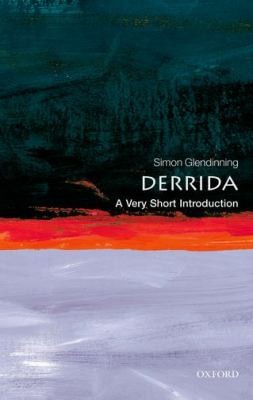
Covers belong to their publishers and are shown so you can recognise the book.
Who they connect to
Influenced
- Gayatri Spivak · She translated his book Of Grammatology into English and used his method of reading.
Influenced by
- Edmund Husserl · He began with close studies of Husserl and turned his ideas against themselves.
- Emmanuel Levinas · He wrote a well-known essay on Levinas and took from him the stress on the other.
- Friedrich Nietzsche · He drew on Nietzsche's view that truth is bound to interpretation and style.
- Martin Heidegger · He took up Heidegger's criticism of Western thought and reworked it into his own method.
Other Poststructuralist thinkers
- Jacques Lacan · 1901 to 1981
- Gilles Deleuze · 1925 to 1995
- Julia Kristeva · born 1941
- Judith Butler · born 1956
Sources we used
- Jacques Derrida · Stanford Encyclopedia of Philosophy, read on 29 October 2026
- Jacques Derrida · Wikipedia, read on 29 October 2026