
Paulo Freire
Latin American · Latin America · 1921 to 1997
Brazilian educator who held that education should be a dialogue of equals, helping the poor to name and change their world.
What it is
Paulo Freire (1921 to 1997) was a Brazilian educator and one of the most influential thinkers about education of the twentieth century. He taught that learning to read and write should help people understand their own world and change it. His goal was to end illiteracy among people from formerly colonised places, and he held that education is never neutral.
He was born in Recife and grew up knowing hunger during the Great Depression. His father died when he was a boy. He studied law, philosophy and the psychology of language, and from 1947 he worked with illiterate peasants and workers in the north-east of Brazil. He lived in exile from 1964 to 1980, mostly working in Chile at first. Back in Brazil he helped found the Workers' Party and served as Secretary of Education of São Paulo.
The main ideas
- The banking model. He criticised teaching in which the teacher deposits information into students as if they were empty accounts. He thought this treats learners as things, not people, and he compared it to colonisation.
- Problem-posing education. In its place he proposed dialogue between teacher and students, in which everyone teaches and everyone learns, and the classroom itself shows the democracy it aims for.
- Conscientização. He used the Portuguese word conscientização for becoming aware of the social and political contradictions around you and then acting against what oppresses you. People who live under oppression often absorb it without knowing.
- Not becoming the oppressor. In his most famous book he warned that the oppressed must not become oppressors in turn. Only they, he said, can free both themselves and those who oppress them.
- Charity and justice. He argued that false generosity depends on injustice continuing, and that those who want to help must first listen to the people they help.
- Humanism. He drew on existentialism, phenomenology, Marxism and Christianity in a view of people as always unfinished and able to shape their own lives.
What it looks like in practice
Picture a class where the teacher begins by asking learners to describe the problems in their own neighbourhood, and then builds the reading lessons from the words they use. Freire would say that learners who help to name their world are more likely to become aware of it and to act, than learners who copy words from a list. This is an illustration of his line of questioning, not a passage from his writing.
Books and moments
- Education as the Practice of Freedom (1967) is his first book, finished in Chile.
- Pedagogy of the Oppressed (1968, English edition 1970) is his best-known work. It has been banned in places, and it has been translated into many languages.
Questions and criticism
- A hard style. Critics find his writing wordy and difficult.
- Early language. His first books used male pronouns and examples, which feminist critics objected to. He revised the language in later editions.
- Does it travel? Critics doubt that a method shaped in north-east Brazil can be moved to places with a very different history.
- No ready-made method. Some on the left found his emphasis on dialogue slow, and organisers who asked him for rules were frustrated by his refusal to give them a fixed recipe.
Close neighbours
Marxism and existentialism were among the traditions he drew on, so the pages on Karl Marx and Jean-Paul Sartre show where some of his ideas came from. The page on Frantz Fanon shows another thinker who worked on how oppression shapes the mind.
Written by epchē in our own words, and checked against independent sources on 29 October 2026. The sources are listed below.
Where to start reading
Books by Paulo Freire or about them, from the easiest way in to the harder ones.
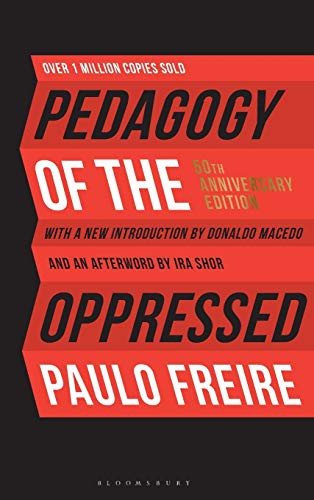
Covers belong to their publishers and are shown so you can recognise the book.
Who they connect to
Influenced
- Enrique Dussel · Both belong to the Latin American current that starts philosophy from the standpoint of the poor. (scholars disagree about this link)
- Linda Tuhiwai Smith · She draws on Freire's view of education as a practice of freedom. (scholars disagree about this link)
Influenced by
- Frantz Fanon · He drew on Fanon's account of how oppressed people come to see their own worth. (scholars disagree about this link)
- Karl Marx · He drew on Marx's view of oppression and class, along with Christian and existential thought. (scholars disagree about this link)
Other Latin American thinkers
- Bartolome de las Casas · 1484 to 1566
- Sor Juana Ines de la Cruz · 1651 to 1695
- Jose Carlos Mariategui · 1894 to 1930
- Leopoldo Zea · 1912 to 2004
- Enrique Dussel · 1934 to 2023
Sources we used
- Paulo Freire · Internet Encyclopedia of Philosophy, read on 29 October 2026
- Paulo Freire · Wikipedia, read on 29 October 2026