
Lucretius
Hellenistic · Europe · 99 to 55 BCE
Roman poet whose long poem On the Nature of Things sets out Epicurean thought and atoms.
What it is
Titus Lucretius Carus was a Roman poet of the first century BCE, and the author of a long poem in six books called On the Nature of Things (in Latin, De rerum natura). The poem sets out the philosophy of Epicurus, above all its picture of a world made of atoms, and it is one of the main ways that philosophy has reached readers today.
Very little is known about the man himself. Most of what a reader can say about his character comes from the poem, which shows a close watcher of the natural world who wanted to free people from fear.
The main ideas
- Atoms and empty space. Everything that exists is made of tiny pieces of matter moving in void. Our world, our bodies and our minds are atoms in motion.
- A small swerve. Atoms are said to veer slightly and at random from their paths. In the Epicurean view this brings an element of chance into the world and helps make room for free will.
- No design. The world was not built for human use by gods and has no purpose written into it. The poem argues against the idea that nature was made for us.
- Gods who do not interfere. Gods may exist, but they take no notice of human affairs and do not answer prayers or punish wrongdoing. Whether this counts as atheism is a question people have argued over.
- Death is nothing to us. The soul is made of matter and dies with the body, so there is nothing to fear afterwards. The third book builds its case and ends by trying to remove the fear of death.
- Calm of mind. The aim of all this is peace of mind, reached through understanding nature and quiet pleasures.
What it looks like in practice
Imagine someone lying awake at night, afraid of dying. A reader of Lucretius would be invited to ask what exactly there is to be afraid of, since death is the end of all feeling and there will be no one left to suffer it. This is an illustration of the style of the poem's argument, not a quotation from it.
Books and moments
- On the Nature of Things. A long poem in six books that sets out a full, natural account of the universe, from atoms to the fate of the world.
- Memmius. The poem is addressed to Memmius, a Roman aristocrat who was later driven into exile after an electoral scandal.
- Book 4. The book ends with a long attack on sexual love.
Questions and criticism
- The story of his madness. A late chronicle says he was driven mad by a love potion, wrote in his clear moments and killed himself. There is no good evidence for it, and both pages find it hard to believe.
- How faithful, and how right? It is fair to ask how closely he follows the teaching of Epicurus, and how much of the ancient science in the poem holds up.
- What were the gods? Epicurus is described as a materialist, not an atheist, yet gods who exist but never act are a puzzling idea, and the sources leave open how they should be understood.
Close neighbours
The page on Epicurus is the nearest, since the poem sets out his teaching. The page on Democritus is also close, as the earlier atomist whose theory Epicurus largely took up. The page on Cicero is related too, because he appears in the old tales about the poem.
Written by epchē in our own words, and checked against independent sources on 29 October 2026. The sources are listed below.
Where to start reading
Books by Lucretius or about them, from the easiest way in to the harder ones.
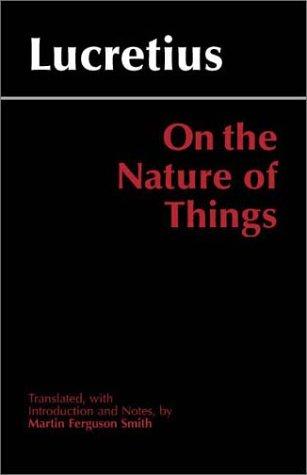
Covers belong to their publishers and are shown so you can recognise the book.
Philosophies they belong to or are close to
Other Hellenistic thinkers
- Antisthenes · 445 to 365 BCE
- Diogenes of Sinope · 412 to 323 BCE
- Crates of Thebes · 365 to 285 BCE
- Pyrrho of Elis · 360 to 270 BCE
- Epicurus · 341 to 270 BCE
- Zeno of Citium · 334 to 262 BCE
- Cleanthes · 331 to 232 BCE
- Chrysippus · 279 to 206 BCE
- Carneades · 214 to 129 BCE
- Cicero · 106 to 43 BCE