
Edmund Burke
Political Conservative · Europe · 1729 to 1797
Anglo-Irish statesman and thinker, widely seen as the founder of modern conservatism. He opposed the French Revolution in his 1790 Reflections.
What it is
Edmund Burke was an Anglo-Irish statesman and political thinker, born in Dublin in 1729 or 1730 (the sources differ) and dead in 1797. He sat in the British House of Commons from 1765 to 1794 as a Whig, and he is often called the founder of modern conservatism, the first writer to set out the case for it in an explicit way.
He was more a speaker and writer on live public questions than a builder of systems, but his work rests on a set of philosophical habits, among them a wariness of abstract theory and a respect for what has grown up over time.
The main ideas
- Judge things in their setting. Burke refused to praise or blame an institution seen only in the abstract, cut off from its history and from the other things it depends on. He distrusted the rationalist and idealist temper of the Revolution and argued against abstract rights.
- Order and change together. He saw society as shaped by history and habit. He accepted that change is unavoidable, and urged that it come by gradual and moderate reform, not by overturning the existing order.
- A representative, not a delegate. An elected member of Parliament, he argued, owes the voters his own judgment and conscience for the good of the whole nation, and should not simply follow their instructions.
- Beauty and the sublime. In a book on aesthetics from his early years he wrote about our ideas of the sublime and the beautiful.
What it looks like in practice
Imagine a town council asked to replace an old market, which has awkward customs and a tangle of rules, with a neat plan drawn up by outside experts. A Burkean would ask what the old arrangements quietly do, who relies on them and what would be lost, and would favour mending over starting again. This is an illustration of his way of asking, not a passage from his writings.
Books and moments
- A Philosophical Enquiry into our ideas of the sublime and beautiful (1757), his early work on aesthetics.
- Reflections on the Revolution in France (1790), the book most linked to his name. It is a critique of the French Revolution, written while the Revolution was still unfolding.
- The split of 1791. His stand on the Revolution broke his links with some of his party colleagues.
- Empire. He spent much of his career on British rule overseas, in North America, India and Ireland, and led the attempt to impeach Warren Hastings over India.
Questions and criticism
- Was he right about France? He judged the Revolution early, before its outcome was clear. It is fair to ask how far events bore out his judgment, and how a thinker should weigh a verdict given in the middle of events.
- Where does respect for the past stop? If change should come slowly, it is fair to ask who decides which inherited things deserve to be kept, and whether the idea can defend a bad but long-standing practice.
- Is he consistent? He argued for conciliation with the American colonists, worked to ease the burdens on Ireland and opposed the French Revolution. It is fair to ask whether one outlook ties these together.
Close neighbours
The pages on Thomas Hobbes and Jean-Jacques Rousseau show two other accounts of why people live under government, which Burke's view can be set beside. The page on Adam Smith belongs to the same century.
Written by epchē in our own words, and checked against independent sources on 29 October 2026. The sources are listed below.
Where to start reading
Books by Edmund Burke or about them, from the easiest way in to the harder ones.
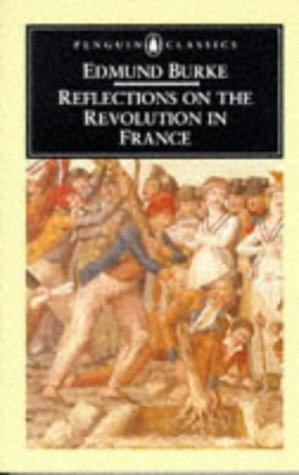
Covers belong to their publishers and are shown so you can recognise the book.
Philosophies they belong to or are close to
Who they connect to
Influenced
- Michael Oakeshott · He took up Burke's view that politics grows out of inherited ways of life, not out of plans. (scholars disagree about this link)
Reacted against by
- Thomas Paine · His book The Rights of Man was written in reply to Burke's attack on the French Revolution.
Other Political Conservative thinkers
- Michael Oakeshott · 1901 to 1990
Sources we used
- Edmund Burke · Stanford Encyclopedia of Philosophy, read on 29 October 2026
- Edmund Burke · Encyclopaedia Britannica, read on 29 October 2026
- Edmund Burke · Wikipedia, read on 29 October 2026
Read more elsewhere
- Stanford Encyclopedia of Philosophy · long and detailed, written by specialists