
Epictetus
Hellenistic · Europe · 50 to 135
Former slave turned Stoic teacher who stressed separating what is up to us from what is not.
What it is
Epictetus (about 55 to 135 CE) was a Greek Stoic teacher, born a slave, who taught that what is up to us is our own judgment and choice, and that freedom and peace of mind come from caring about that and about little else. He wrote nothing himself. His teaching comes to us through his student Arrian, who recorded it in two works, the Discourses and the Handbook.
He was born around 55 CE in Hierapolis, in Phrygia in Asia Minor. He came to Rome as the slave of Epaphroditus, a rich and powerful administrator, and there studied with the Stoic teacher Musonius Rufus. Later he set up his own school at Nicopolis in Greece, and he died around 135. Sources say he walked with a limp, and tell different stories about its cause.
The main ideas
- What is up to us. Some things depend on us and others are largely beyond our control. How well we flourish, he taught, is entirely up to us, because it depends on how we use our own capacity of choice.
- Volition. His central idea is prohairesis, usually translated as volition or moral choice: the faculty by which we decide what to do and what to approve. Keeping it in good order is the task of a life.
- The use of impressions. The second central idea is the correct use of impressions, the way things appear to us. We cannot always control what appears, but we can decide what to make of it.
- Kinship with God. He taught that rational beings are a fragment of God and so kin to God, which gives human beings a worth that no outer circumstance can remove.
- Teaching as examination. He asked students to look hard at these two ideas, and his teaching method was demanding and direct.
What it looks like in practice
Picture someone stuck in traffic who is late for an important meeting. Epictetus would ask them to separate what is up to them, how they respond, from what is not, the traffic and the clock. They can phone ahead and drive carefully, and they can drop the anger that does no one any good. This is an illustration of his teaching, not an example from the Discourses.
Books and moments
- The Discourses record his teaching in the later part of his career, and are the main source.
- The Handbook, or Encheiridion, is a short collection of the central points, easy to carry and to learn.
- His slavery under Epaphroditus and his time with Musonius Rufus are the best-known facts of his early life.
Questions and criticism
- Is everything outside us really beyond us? His line between what is and is not up to us is sharp. It is fair to ask whether things like health or the loss of a loved one can be treated so simply.
- Whose words are these? Arrian says he recorded the teaching as spoken, and readers still ask how closely the text follows Epictetus.
- Freedom for a slave? He spoke of inner freedom after being a slave. Whether his outlook could help those who are not free in other ways is a question people still discuss.
Close neighbours
The page on Stoicism describes the school he taught, and the page on Seneca covers another Roman Stoic.
Written by epchē in our own words, and checked against independent sources on 9 October 2026. The sources are listed below.
Where to start reading
Books by Epictetus or about them, from the easiest way in to the harder ones.
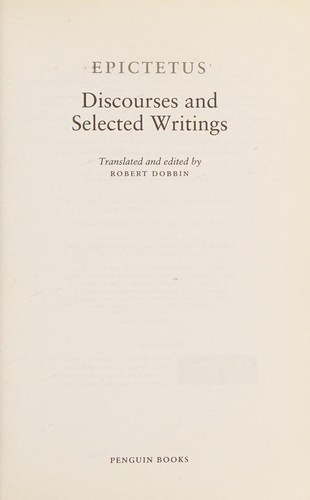
Covers belong to their publishers and are shown so you can recognise the book.
Philosophies they belong to or are close to
Who they connect to
Influenced
- Marcus Aurelius · Marcus thanks a teacher for lending him Epictetus's lectures.
Other Hellenistic thinkers
- Antisthenes · 445 to 365 BCE
- Diogenes of Sinope · 412 to 323 BCE
- Crates of Thebes · 365 to 285 BCE
- Pyrrho of Elis · 360 to 270 BCE
- Epicurus · 341 to 270 BCE
- Zeno of Citium · 334 to 262 BCE
- Cleanthes · 331 to 232 BCE
- Chrysippus · 279 to 206 BCE
- Carneades · 214 to 129 BCE
- Cicero · 106 to 43 BCE