
Kwasi Wiredu
African · Africa · 1931 to 2022
Ghanaian philosopher who argued that African concepts should be examined critically, and that government should work by consensus.
What it is
Kwasi Wiredu (1931 to 2022) was a philosopher from Ghana, born in Kumasi, who studied in Ghana and at Oxford. He was a leading voice in contemporary African philosophy.
For decades he was involved in a project he called conceptual decolonization: re-examining the habits of thought in modern Africa so as to set aside both unhelpful parts of traditional culture and unnecessary Western assumptions. He worked with the concepts of his own Akan language to do this, and he also wrote on truth, mind and politics.
The main ideas
- Conceptual decolonization. He asked African thinkers to examine inherited ways of thinking and to drop what is uncritical in both the traditional and the colonial inheritance.
- Philosophy as critical analysis. Folk thought and tradition can contribute to philosophy, but genuine philosophy needs rigorous argument and critical analysis applied to them.
- Akan concepts. He studied the Akan concepts of truth, mind and person as a test case. His essay on truth argues that Akan has no single word for truth in the way English does.
- Consensual democracy. He argued that the traditional Ashanti system was a democracy by consent, with decisions reached by consensus and not by majority vote, and he proposed it as a model.
What it looks like in practice
Picture a committee in a village that will not take a decision until even those who disagree can live with it, and that regards long discussion as a reasonable price. Wiredu used this kind of procedure, as he found it in Akan tradition, to ask whether majority rule is the only form democracy can take. This is an illustration of the idea, not a quotation.
Books and moments
- Philosophy and an African Culture is a collection of his essays on tradition, ideology and truth.
- Cultural Universals and Particulars is his book on how African thought connects to universal questions.
- Democracy and Consensus in African Traditional Politics is his essay arguing for a non-party polity.
Questions and criticism
- Can tradition be both respected and corrected? His project asks Africans to keep what is valuable in tradition and drop what is not, and the criteria for choosing are debated.
- Is consensus a practical model? His consensual democracy has been admired and also doubted as a form of government for large modern states.
- What does language show about concepts? His reading of the Akan language raises the question of how far the words of a language shape its philosophy.
Close neighbours
He studied Western philosophy and Akan thought together. The page on Ubuntu and the page on Ramose show another effort to think from African concepts.
Written by epchē in our own words, and checked against independent sources on 9 October 2026. The sources are listed below.
Where to start reading
Books by Kwasi Wiredu or about them, from the easiest way in to the harder ones.
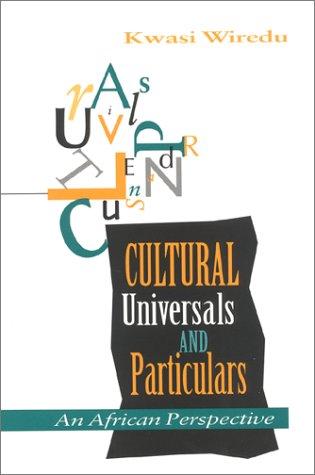
Covers belong to their publishers and are shown so you can recognise the book.
Who they connect to
Influenced
- Henry Odera Oruka · Both called for critical, reasoned African philosophy as opposed to a mere record of beliefs. (scholars disagree about this link)
Influenced by
- John Dewey · Wiredu wrote on pragmatism and held that ideas should be judged by their practical use. (scholars disagree about this link)
Runs parallel to
- Kwame Gyekye · The two Ghanaian philosophers argued over African concepts and tradition, and shaped each other's work.
- Mogobe Ramose · Both work on African concepts and the politics of African philosophy, from different positions. (scholars disagree about this link)
Other African thinkers
- Zera Yacob · 1599 to 1692
- Anton Wilhelm Amo · 1703 to 1759
- Leopold Sedar Senghor · 1906 to 2001
- Kwame Nkrumah · 1909 to 1972
- Alexis Kagame · 1912 to 1981
- Julius Nyerere · 1922 to 1999
- Cheikh Anta Diop · 1923 to 1986
- Frantz Fanon · 1925 to 1961
- John Mbiti · 1931 to 2019
- Kwame Gyekye · 1939 to 2019
Sources we used
- Kwasi Wiredu · Internet Encyclopedia of Philosophy, read on 9 October 2026
- Kwasi Wiredu · Wikipedia, read on 9 October 2026