
Cynicism
Hellenistic · Europe · from 400 BCE
The Cynics were ancient Greeks who lived with almost nothing. They said virtue is all a person needs to be happy, and that wealth, rank and social custom are false. They tried to live in line with nature and to speak the truth without fear.
What it is
Cynicism, in the ancient Greek sense, is a way of life that held that virtue is all a person needs to be happy, and that rejected wealth, status and social convention as false and limiting. It is a practice more than a theory. The Cynics claimed to follow Socrates, but what they handed on was less a body of doctrine than a way of living, built on self-training.
This is not the modern meaning of the word. Today a cynic is someone who believes that people act from bad motives. The ancient Cynics were something else: people who thought that most of what society tells us to want gets in the way of a good life.
The main ideas
- Virtue is enough for happiness. Nothing else is necessary for a good life.
- Nature over convention. The Cynics held that a good life is lived in accord with nature. Customs about wealth, power and reputation are arbitrary, and they cost us freedom.
- Self-sufficiency and simple living. Freedom comes from needing little.
- Shamelessness. They treated shamelessness as superior to modesty, as a way of being free from false limits.
What it looks like in practice
Picture someone who notices how much of their week is spent keeping up appearances: the right clothes, the right phrases, the right opinions. A Cynic would ask which of that they would still do if nobody was watching, and would drop the rest. The point is not to be rude. It is to find out how much of one's life was held up by convention alone.
The Cynics trained for this on purpose, through a discipline of self-training. The aim was a life that needs little.
People and moments
- Antisthenes, a pupil of Socrates, is the traditional start of the movement.
- Diogenes of Sinope is the best-known Cynic. He is said to have lived in a jar. When Alexander the Great offered him anything he wished, he is said to have asked the king to stand out of his light.
- Crates of Thebes gave up his fortune to live as a Cynic.
- Zeno of Citium, who founded Stoicism, is placed in this line of thought.
Questions and criticism
- Did they reject politics altogether? Some see the Cynics as origins of anarchism, because they rejected political structures.
- Shamelessness and poverty. Christian writers later criticised their shamelessness but praised their poverty.
- A later revival. The movement revived under the Roman Empire, with Cynics preaching in the cities.
Close neighbours
Cynicism is closest to Stoicism, which it influenced: Zeno, the founder of the Stoics, is placed in the Cynic line, and both hold that virtue is enough for happiness.
Written by epchē in our own words, and checked against independent sources on 2 October 2026. The sources are listed below.
Where to start reading
Books for this philosophy, from the easiest way in to the harder ones. Each is chosen for a newcomer, whatever the shop.
- Lives of the Eminent Philosophers Diogenes Laertius
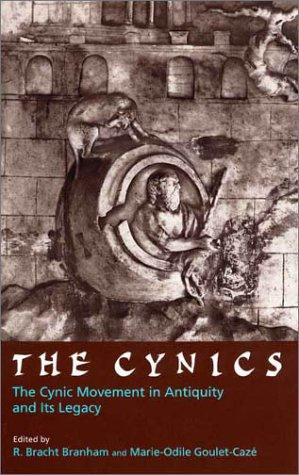
Covers belong to their publishers and are shown so you can recognise the book.
What it holds
These are the questions this philosophy cares about most and the side it leans toward. They are our reading of it, and the same positions the walk uses.
- Being a good person · clearly Is ethics mostly about which acts are right, or about what kind of person you become?
- Question and change · clearly Should we trust old customs and institutions, or question and change them?
- The person comes first · clearly When a person's wishes and the community's needs pull apart, which should come first?
- Something is higher than pleasure · clearly Is the best life the one with the most calm pleasure and the least pain?
Ideas it speaks to
Short articles on the questions this philosophy answers most firmly.
- Acts or character in ethics · leans toward: Being a good person
- Tradition or change · leans toward: Question and change
- The person or the community first · leans toward: The person comes first
- Is pleasure the highest good · leans toward: Something is higher than pleasure
Compared with
Thinkers
Related philosophies
Influenced
- Stoicism · The Cynic stress on virtue shaped Stoicism, and Zeno of Citium came from this line.
More from the Hellenistic tradition
Sources we used
- Cynicism · Internet Encyclopedia of Philosophy, read on 2 October 2026
- Cynicism (philosophy) · Wikipedia, read on 2 October 2026
Where do you stand?
Every philosophy takes sides. Here is one question Cynicism answers firmly:
Is ethics mostly about which acts are right, or about what kind of person you become?
- Cynicism leans toward: Being a good person
- The other side: Which acts are right
The walk asks about this and the questions around it, two ideas at a time, and shows which philosophies your own answers sit closest to. No account, and your answers stay on your device.