
Rationalism
Continental Rationalism · Europe · from 1637
Rationalism says clear thinking, more than the senses, is our best path to knowledge. Careful reasoning can show us deep truths about the world and the mind.
What it is
Rationalism is the view that reason, not the senses alone, is the main source of knowledge. Its great seventeenth century thinkers held that the mind has some ideas and truths of its own, and that careful reasoning, like mathematics, can reach certain knowledge of how things are.
The word is used mainly for the seventeenth and eighteenth century thinkers of continental Europe, above all Descartes, Spinoza and Leibniz. It is a label applied afterwards, in contrast with the British empiricists, Locke, Berkeley and Hume. The dispute between the two camps is a question of how far we depend on experience to gain knowledge.
The main ideas
- Reason can know some things by itself. Some truths can be known by intuition alone, and others deduced from those. Some knowledge and some concepts are part of our nature, and knowledge by reason is better than knowledge from the senses.
- Innate ideas. The mind is not a blank page. Descartes's idea of a perfect being is an example of one that experience could not supply.
- The model of mathematics. The rationalists took geometry as a pattern: start from self-evident axioms and reason step by step.
- A world that makes sense. The guiding assumption is that reality is intelligible and that reason can grasp it, with no brute facts left unexplained.
- Large systems. Each of the three built a system about the basic nature of what exists.
What it looks like in practice
Picture someone who is asked how they know that two plus two is four, or that a triangle has three sides. They did not learn it by counting a thousand triangles. They see that it must be so, whatever the world is like. The rationalist takes this as the model of knowledge, and asks what else might be known the same way.
The empiricist replies that even those truths come from experience, or tell us little about the world. The argument between them is still a live one.
People and moments
- René Descartes (1596 to 1650) is the founder of the method. He is known for treating mind and body as two kinds of thing and for 'clear and distinct' ideas.
- Baruch Spinoza held that there is only one substance and set out his philosophy in geometric form.
- Gottfried Leibniz argued from the principle of sufficient reason and gave the most worked-out case for innate ideas.
Questions and criticism
- The empiricist reply. Rationalism is usually set against empiricism. Locke, Berkeley and Hume answered that knowledge begins in experience, and that the idea of innate knowledge is hard to make sense of.
- What can pure reason tell us? It is fair to ask whether truths reached by reason alone tell us anything substantial about the world, or only about the relations between our ideas.
Close neighbours
Rationalism is opposed to British empiricism, the school of Hume, and Kant tried to join the two. In ethics, rationalists lean toward finding moral truths by reason, as in Kantian ethics.
Written by epchē in our own words, and checked against independent sources on 7 October 2026. The sources are listed below.
Where to start reading
Books for this philosophy, from the easiest way in to the harder ones. Each is chosen for a newcomer, whatever the shop.
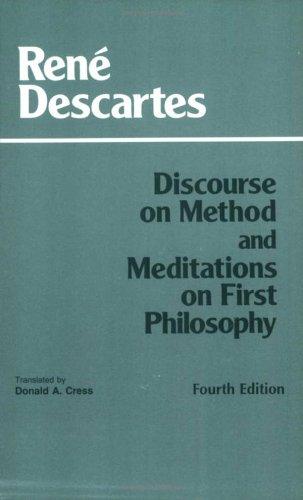

Covers belong to their publishers and are shown so you can recognise the book.
What it holds
These are the questions this philosophy cares about most and the side it leans toward. They are our reading of it, and the same positions the walk uses.
- Reason is the best guide · clearly Where does the most reliable knowledge come from: careful thinking, or what we see, hear and test?
- Some things are certain · clearly Can we be sure of some things, or can almost everything be doubted?
- Truth matches reality · clearly Is a belief true because it matches how things really are?
- Things have a lasting nature · clearly Do things have a fixed nature that lasts, or is the world better seen as constant change?
- A lasting self · clearly Is there a real, lasting you under your thoughts and feelings?
- Mind is more than the physical · clearly Is everything made of physical stuff, or is mind or spirit something more?
- Some things are wrong for everyone · clearly Are some moral rules true for everyone, everywhere?
Ideas it speaks to
Short articles on the questions this philosophy answers most firmly.
- Reason or experience · leans toward: Reason is the best guide
- Certainty and doubt · leans toward: Some things are certain
- What makes something true · leans toward: Truth matches reality
- Permanence and change · leans toward: Things have a lasting nature
- The self and personal identity · leans toward: A lasting self
- Mind and matter · leans toward: Mind is more than the physical
Compared with
Thinkers
Sources we used
- Rationalism vs. Empiricism · Stanford Encyclopedia of Philosophy, read on 7 October 2026
- Rationalism, Continental · Internet Encyclopedia of Philosophy, read on 7 October 2026
- René Descartes · Stanford Encyclopedia of Philosophy, read on 9 October 2026
- Immanuel Kant: Metaphysics · Internet Encyclopedia of Philosophy, read on 9 October 2026
Read more elsewhere
- Stanford Encyclopedia of Philosophy · long and detailed, written by specialists
Where do you stand?
Every philosophy takes sides. Here is one question Rationalism answers firmly:
Where does the most reliable knowledge come from: careful thinking, or what we see, hear and test?
- Rationalism leans toward: Reason is the best guide
- The other side: Experience is the best guide
The walk asks about this and the questions around it, two ideas at a time, and shows which philosophies your own answers sit closest to. No account, and your answers stay on your device.