
René Descartes
Continental Rationalism · Europe · 1596 to 1650
French thinker who tried to find certain foundations for knowledge by doubting everything he could. He also argued that mind and body are different things.
What it is
René Descartes (1596 to 1650) was a French mathematician, scientist and philosopher, often called the father of modern philosophy. He set out to rebuild human knowledge from a starting point that could not be doubted, and he found it in the fact that he exists as a thinking thing. He also pictured nature as matter that moves by a few universal laws, an idea that shaped modern science.
He was born on 31 March 1596 in La Haye, in the Touraine region of France, and studied at the Jesuit college of La Flèche. He spent most of his working life in the Netherlands. In 1649 he moved to Sweden at the invitation of Queen Christina, and he died there the next year.
The main ideas
- Doubt as a method. Descartes decided to treat any belief that could be doubted, even slightly, as false for the time being. The point was not to stay a sceptic. It was to clear away unexamined opinions and begin the search for truth with nothing taken for granted.
- "I exist" cannot be doubted. Even if he is wrong about everything else, he must exist in order to be wrong. This starting point is known as the cogito, from the Latin phrase usually quoted as "I think, therefore I am".
- God and clear ideas. From that firm point he argued that God exists and is not a deceiver. That, in turn, was meant to guarantee that whatever we understand clearly and distinctly is true. Critics have long asked whether the reasoning goes in a circle, and the objection is known as the Cartesian circle.
- Mind and body are different. For Descartes the essence of mind is thought, and the essence of matter is being extended in space. The immaterial mind is really distinct from the body. This view led to what is now called the mind-body problem: how two such different things can affect each other.
- A mechanical nature. He described the physical world as matter with a few basic properties that acts according to universal laws. He rejected the older habit of explaining things by their purposes and applied the mechanical picture to animals and the human body.
- Mathematics and science. He developed techniques that made algebraic geometry possible, and he treated geometry as the model of clear ideas.
What it looks like in practice
Picture someone who has just discovered that something they were certain of was false, perhaps a belief they had held for years. A Cartesian response is not to doubt everything for ever, but to ask which of their beliefs would survive if they were tested one at a time. The ones that survive can be built on. The ones that do not can be set aside without panic. The habit is to hold a belief only as firmly as the reasons allow, and to know what those reasons are.
Works and moments
- Discourse on the Method (1637) set out his approach in French, together with essays on optics, weather and geometry.
- Meditations on First Philosophy (1641) is the short, careful work that contains the argument from doubt to the thinking self and to God, and it was published with objections from other thinkers and his replies.
- The Passions of the Soul (1649) is his study of the emotions and appeared just before he left for Sweden.
Questions and criticism
- Can mind and body really be so different? If the mind is not in space and the body is, it is hard to say how a decision to raise an arm moves the arm. Descartes' own account of the link has never satisfied everyone.
- Is the argument circular? He relies on clear and distinct ideas to prove that God exists, and on God to prove that clear and distinct ideas can be trusted. Whether he escapes the circle is still discussed.
- Does "I think" prove enough? It is fair to ask how much follows from the bare fact of thinking. Some readers say it establishes that something is thinking, but not much about what that something is.
Close neighbours
Descartes is usually grouped with Spinoza and Leibniz as the great continental rationalists, in contrast with the British empiricists Locke, Berkeley and Hume, who started from experience and not from reason alone. The philosophy page on rationalism describes the school he is counted with.
Written by epchē in our own words, and checked against independent sources on 9 October 2026. The sources are listed below.
Where to start reading
Books by René Descartes or about them, from the easiest way in to the harder ones.
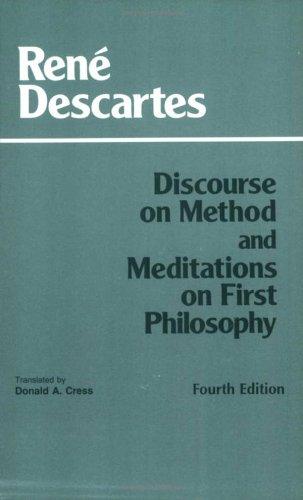
Covers belong to their publishers and are shown so you can recognise the book.
Philosophies they belong to or are close to
Who they connect to
Influenced
- Anton Wilhelm Amo · Amo worked within the mind and body problem set by Descartes.
- Baruch Spinoza · Spinoza began from Descartes' method and reworked its conclusions.
- Edmund Husserl · Husserl called his method a new Cartesianism and started from the certainty of consciousness.
- Gottfried Leibniz · Leibniz took up and challenged Descartes' physics and philosophy of mind.
- Mary Astell · She drew on Descartes' stress on clear reasoning as open to every mind.
- Nicolas Malebranche · Malebranche said that reading Descartes' Treatise on Man set him on his path.
Influenced by
- Anselm of Canterbury · Descartes' argument in the Fifth Meditation revived the reasoning of Anselm's argument from the idea of God.
- Augustine of Hippo · Critics pointed out that Augustine had used an argument from doubt to existence before Descartes. (scholars disagree about this link)
- Sextus Empiricus · Renewed reading of Sextus in the sixteenth century set the sceptical problems Descartes tried to answer.
Reacted against by
- Anton Wilhelm Amo · Amo argued that the mind does not itself sense, rejecting Descartes' view of mind and body interacting. (scholars disagree about this link)
- Baruch Spinoza · Spinoza rejected Descartes' split between mind and body.
- Blaise Pascal · Pascal called Descartes' philosophy useless and uncertain and put the heart's reasons beside those of reason.
- Giambattista Vico · Vico argued that the human world made by people is better known than nature, against Cartesian method.
- Gilbert Ryle · His best-known book attacks what he called the Cartesian myth of a mind separate from the body.
- John Locke · Locke rejected innate ideas.
- Julien Offray de La Mettrie · He took Descartes' picture of animals as machines and applied it to human beings too.
- Maurice Merleau-Ponty · He criticised the Cartesian picture of mind as a detached observer.
- Thomas Hobbes · Hobbes wrote critical objections to Descartes' Meditations.
Runs parallel to
- Francis Bacon · Both set out to rebuild knowledge on a new method, though one began with observation and the other with reason.
- Ibn Sina (Avicenna) · His floating-man thought experiment is often compared to Descartes' arguments about the mind. (scholars disagree about this link)
- Zera Yacob · Both describe starting an inquiry alone, by reason, about God and how to live. (scholars disagree about this link)
Other Continental Rationalism thinkers
- Baruch Spinoza · 1632 to 1677
- Nicolas Malebranche · 1638 to 1715
- Gottfried Leibniz · 1646 to 1716
Sources we used
- René Descartes · Stanford Encyclopedia of Philosophy, read on 9 October 2026
- René Descartes · Internet Encyclopedia of Philosophy, read on 9 October 2026
- Continental Rationalism · Internet Encyclopedia of Philosophy, read on 9 October 2026