
Baruch Spinoza
Continental Rationalism · Europe · 1632 to 1677
Dutch philosopher who argued that God and nature are the same. He said everything happens as it must, and that freedom comes from understanding.
What it is
Baruch Spinoza (1632 to 1677) was a Dutch philosopher who held that God and Nature are one and the same, that everything follows from that nature by necessity, and that human happiness comes from understanding this and learning to master the passions. He is counted among the most important and the most radical thinkers of the seventeenth century, and he is still argued over today.
He was born in 1632 in Amsterdam, into a Jewish family in Amsterdam. In 1656 that community pronounced a ban of excommunication on him, and it was never lifted. He went on to write the Ethics, his best-known work, and the Theological-Political Treatise, which he published without his name in 1670. Some of his writing appeared only after his death in 1677.
The main ideas
- God or Nature. There is one substance, which he calls God, and everything else that exists is in it. This is not a creator standing outside the world and ruling it by providence. God is Nature itself, an infinite system of which human beings are a part. His phrase for it was Deus sive Natura, 'God or Nature'.
- Everything follows by necessity. In his picture, things follow from the nature of God as an effect follows from its cause. There are no other possible worlds and nothing within the world could have been otherwise. He denied that God made the world by a free and arbitrary choice.
- No free will. For the same reason he treated the belief in a free will standing outside the chain of causes as a mistake. Human freedom, for him, is a matter of understanding what moves us, not of escaping causes.
- The passions. Our emotions, such as fear and hope, are part of nature too and can be understood. His moral philosophy is about learning to understand and control them, which leads to virtue and to happiness.
- Striving to persist. Each thing strives to continue in its own being. He called this striving conatus and treated it as the essence of the thing.
- Freedom of thought and democracy. In the Theological-Political Treatise he argued that a society is made more stable, not less, when people are free to think and to philosophise. His political thought was democratic, and he was critical of clergy who play on people's fears.
What it looks like in practice
Picture someone who is furious at a colleague who let them down. On Spinoza's view the anger has causes, in the colleague's history and in the person's own, and the first step is to see them. That does not mean approving of what happened. It means that the more clearly the person understands why things went as they did, the less the anger rules them, and the better they can decide what to do. This is an illustration of the attitude, not a quotation.
Books and moments
- Ethics is his main work. It sets out the view of God, nature, the mind and the passions in a connected order, and ends with how a person can live well.
- Theological-Political Treatise (1670) defends freedom of thought and criticises clergy who work on people's fears and superstitions. It was published anonymously and caused alarm.
- The ban of 1656 cut him off from the community he grew up in.
Questions and criticism
- Hero or enemy? Some see him as a herald of enlightened modernity, calling people to live by the guidance of reason. Others see him as an enemy of the traditions that sustain us.
- Is it still God? A God who is simply Nature, without purposes or providence, is for many believers no God at all. It is fair to ask what is left of religion, or of hope, in his picture.
- What is left of choice? If nothing could have been otherwise, it is fair to ask what praise, blame and deliberation mean. His answer is that understanding makes us freer, but readers disagree on whether that is enough.
Close neighbours
Spinoza began from the philosophy of Descartes and combined it with elements from Stoicism, Hobbes and medieval Jewish rationalism. The page on Descartes and the page on rationalism show the tradition he worked within and changed.
Written by epchē in our own words, and checked against independent sources on 9 October 2026. The sources are listed below.
Where to start reading
Books by Baruch Spinoza or about them, from the easiest way in to the harder ones.
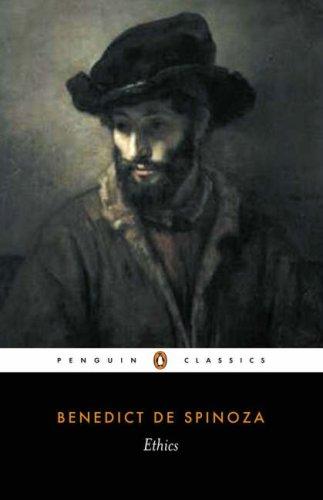
Covers belong to their publishers and are shown so you can recognise the book.
Philosophies they belong to or are close to
Who they connect to
Influenced
- Arne Naess · He drew on Spinoza's view of all things as parts of one whole.
- F. W. J. Schelling · Schelling's philosophy of nature took up Spinoza's picture of a single living whole.
- George Santayana · He admired Spinoza and wrote about him often. (scholars disagree about this link)
- Gilles Deleuze · He wrote two books on Spinoza and took from him a picture of reality as a single field of forces.
Influenced by
- René Descartes · Spinoza began from Descartes' method and reworked its conclusions.
- Thomas Hobbes · Spinoza's political thought takes up Hobbes' account of natural right and the state.
Reacted against
- Moses Maimonides · Spinoza criticised Maimonides' way of reading scripture in the Theological-Political Treatise.
- René Descartes · Spinoza rejected Descartes' split between mind and body.
Runs parallel to
- Shankara · Both defend a monist view in which everything is one reality. (scholars disagree about this link)
Other Continental Rationalism thinkers
- René Descartes · 1596 to 1650
- Nicolas Malebranche · 1638 to 1715
- Gottfried Leibniz · 1646 to 1716
Sources we used
- Baruch Spinoza · Stanford Encyclopedia of Philosophy, read on 9 October 2026
- Spinoza, Benedict De · Internet Encyclopedia of Philosophy, read on 9 October 2026