
Adam Smith
Scottish Enlightenment · Europe · 1723 to 1790
Scottish thinker who based morals on sympathy and on imagining a fair, neutral observer. He also studied how trade creates wealth.
What it is
Adam Smith (1723 to 1790) was a Scottish moral philosopher and political economist, born in Kirkcaldy and a leading figure of the Scottish Enlightenment. He is best known for two books: The Theory of Moral Sentiments (1759) and An Inquiry into the Nature and Causes of the Wealth of Nations (1776).
He is usually remembered as the founder of modern economics, but he held a chair of moral philosophy, and his first book is a work of ethics. A thread running through both books is trust in the judgment of ordinary people and a worry about grand systems devised by thinkers and rulers to replace it.
The main ideas
- Sympathy. We judge others, and ourselves, by imagining how we would feel in their place. Moral feeling grows out of this shared sentiment.
- The impartial spectator. Conscience works like an imagined, fair-minded observer who looks at our conduct as an outsider would.
- Division of labour. In The Wealth of Nations he argued that dividing work into specialised tasks greatly raises what a society can produce.
- The invisible hand. People who pursue their own interests in a market can, without intending it, serve the wider good.
What it looks like in practice
Picture someone deciding whether to tell a small lie that would help them at a friend's expense. Smith's test would be to imagine how a calm, informed onlooker would judge the act, and to let that imagined view guide the decision. This is an illustration of the idea, not a quotation.
Books and moments
- The Theory of Moral Sentiments (1759) is his book on how moral judgment arises from sympathy.
- The Wealth of Nations (1776) is his book on how nations grow rich, through division of labour and trade.
- His lectures on jurisprudence survive in student notes and add to his views on law and government.
Questions and criticism
- Are the two books consistent? The first stresses sympathy and the second self-interest, and readers have long asked how they fit together.
- Does the market serve the common good? The invisible hand has been taken as a defence of markets, but its meaning in his own work is debated.
- Do all people share the same moral sense? His account assumes that sympathy works much the same in everyone, which critics have questioned.
Close neighbours
David Hume was one of his closest friends. The pages on Hume and Utilitarianism show related ideas from the same Scottish setting.
Written by epchē in our own words, and checked against independent sources on 9 October 2026. The sources are listed below.
Where to start reading
Books by Adam Smith or about them, from the easiest way in to the harder ones.
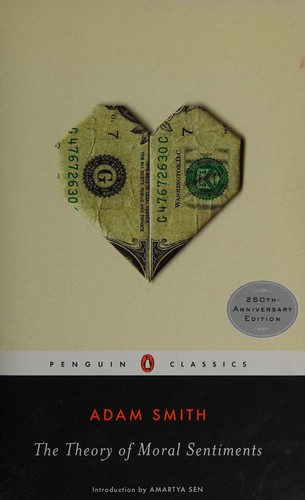
Covers belong to their publishers and are shown so you can recognise the book.
Who they connect to
Influenced
- Amartya Sen · He often draws on Smith's views on sympathy, markets and justice.
- John Stuart Mill · Mill's economics extends the classical tradition of Smith.
- Karl Marx · Marx began his study of capital with the classical economists, Smith first among them.
- Martha Nussbaum · Nussbaum draws on Smith's idea of sympathy in her work on emotions and justice. (scholars disagree about this link)
Influenced by
- Bernard Mandeville · Smith took up the thought that private gain can serve the public, and also argued against him. (scholars disagree about this link)
- David Hume · Smith was Hume's close friend and built his moral theory on Hume's sympathy.
- Francis Hutcheson · Smith studied under him in Glasgow and built on his account of moral feeling.
Reacted against by
- Karl Marx · Marx criticised Smith's account of value and of a harmonious market.
Other Scottish Enlightenment thinkers
- Francis Hutcheson · 1694 to 1746
- Thomas Reid · 1710 to 1796
Sources we used
- Adam Smith · Stanford Encyclopedia of Philosophy, read on 9 October 2026
- Adam Smith · Internet Encyclopedia of Philosophy, read on 9 October 2026
- Adam Smith · New World Encyclopedia, read on 9 October 2026
- Adam Smith · Wikipedia, read on 9 October 2026