
David Hume
British Empiricism · Europe · 1711 to 1776
Scottish thinker who said all our knowledge comes from experience. He questioned what we really know about cause and effect, and about the self, and said morals rest on feeling.
What it is
David Hume (1711 to 1776) was a Scottish philosopher and historian who held that all our ideas come from experience, that our belief in cause and effect rests on habit and not on proof, and that moral judgment rests on feeling more than on reason. He is one of the most influential thinkers in the English-speaking tradition, and his questions about knowledge and belief are still taught as a starting point.
He was born in 1711 in Scotland, in or near Edinburgh, and he wrote his most important philosophical work as a young man. His Treatise of Human Nature was published anonymously in 1739 and 1740. It did not bring the reception he had hoped for. He turned to shorter and clearer versions of his ideas and to history, and he never held a university chair. In 1752 he became librarian of the Advocates Library in Edinburgh, and between 1754 and 1762 he published a six-volume History of England that was widely read.
The main ideas
- Ideas come from experience. The mind's contents are impressions, which are vivid, and ideas, which are fainter copies of them. We have no idea that we could not trace back to some impression.
- Cause and effect. We never perceive a power that makes one event produce another. We see events that regularly go together, and habit leads us to expect the second after the first. The feeling that the connection is necessary comes from us and not from the world.
- The self as a bundle. When Hume looked inward he found a stream of perceptions and no single thing that is 'I'.
- Reason does not move us. Reason alone cannot make us act. Desire and feeling do. So a moral judgment cannot come from reason alone.
- Morals rest on feeling. Right and wrong are felt, through approval and disapproval. Justice, on his view, is an artificial virtue, a human invention that serves everyone, though it still rests on sentiment.
- Religion. He doubted that testimony could establish miracles, and he examined the arguments for God's existence closely, most fully in the Dialogues concerning Natural Religion.
What it looks like in practice
Picture someone who is completely sure that the sun will rise tomorrow. Hume does not ask them to doubt it. He asks them to notice that the certainty is a habit built up from every earlier sunrise, not a proof, and that the habit is still a good guide for living. The same attitude applies to a moral quarrel. Before asking what reason demands, he would ask what people actually feel, and whether the feeling would survive if they looked at the matter from the other person's side.
Books and moments
- A Treatise of Human Nature (1739 to 1740) is his first and most ambitious work.
- An Enquiry concerning Human Understanding (1748) restates the theory of knowledge in a shorter and more readable form.
- An Enquiry concerning the Principles of Morals (1751) does the same for ethics.
- Dialogues concerning Natural Religion was published in 1779, three years after he died. It is his fullest examination of arguments about God.
Questions and criticism
- How sceptical was he? Readers disagree about how to fit his doubts about reason together with his plan for a 'science of man'. Some see a thorough sceptic, others a thinker who accepts the limits of reason in order to study human nature.
- Critics in his own day. The Scottish philosopher James Beattie attacked his views in print, and Hume was upset by it.
- Is a habit enough? If our belief in cause and effect is only habit, it is fair to ask what could ever justify trusting it, and what Hume himself thought could.
Close neighbours
Hume was influenced by Locke and is the empiricist side of the old contrast with the rationalists. Later thinkers including Adam Smith and Jeremy Bentham took up his ideas. The page on Humean empiricism describes the school of thought that bears his name.
Written by epchē in our own words, and checked against independent sources on 9 October 2026. The sources are listed below.
Where to start reading
Books by David Hume or about them, from the easiest way in to the harder ones.
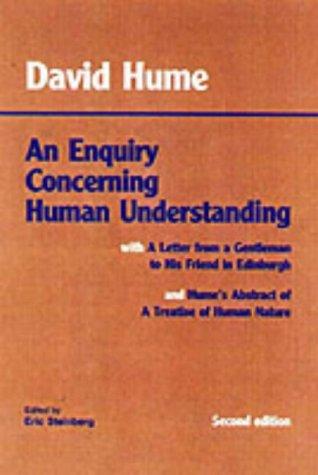
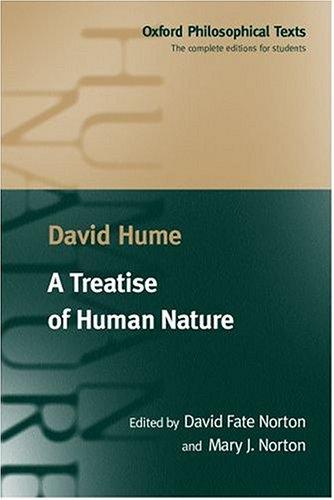
Covers belong to their publishers and are shown so you can recognise the book.
Philosophies they belong to or are close to
Who they connect to
Influenced
- A. J. Ayer · He called himself a follower of Hume and took from him the split between facts and meanings.
- Adam Smith · Smith was Hume's close friend and built his moral theory on Hume's sympathy.
- Auguste Comte · Comte took over Hume's idea that knowledge is limited to observed regularities.
- Bernard Williams · Williams' internal reasons view of motivation follows Hume.
- Bertrand Russell · Russell's empiricism follows Hume in tying knowledge to experience.
- Derek Parfit · Parfit's reductionist view of persons follows Hume's bundle theory of the self.
- Ernst Mach · He called Hume a forerunner and shared his view that the self and the world are bundles of sensations.
- Immanuel Kant · Kant said Hume woke him from his dogmatic slumber.
- Karl Popper · Popper began from Hume's problem of induction and gave a new answer.
- W. V. O. Quine · Quine treats Hume's puzzle about evidence as the starting point of his own view that the study of knowledge is part of science.
Influenced by
- Bernard Mandeville · Hume took up his view that customs and trade grow from desire and habit, not from plans. (scholars disagree about this link)
- Cicero · Hume admired Cicero and modelled his dialogue on religion on Cicero's dialogue on the gods.
- Francis Hutcheson · Hume built his account of morals on feeling on Hutcheson's moral sense.
- George Berkeley · Hume built on Berkeley's arguments against unobserved substance.
- Joseph Butler · Hume read him and took up his stress on human nature as the base of morals. (scholars disagree about this link)
- Nicolas Malebranche · Hume's arguments about cause and effect pick up Malebranche's claim that no necessary link is seen.
- Sextus Empiricus · Hume's mitigated scepticism echoes the ancient sceptics, whom he knew through Bayle. (scholars disagree about this link)
- Thomas Hobbes · Hume inherited Hobbes' naturalistic study of human passions and convention.
Reacted against by
- Thomas Reid · Reid's Inquiry was written to refute the sceptical results of Hume's account of ideas.
Runs parallel to
- Al-Ghazali · Al-Ghazali's doubts about causation are often compared with Hume's. (scholars disagree about this link)
Other British Empiricism thinkers
- Francis Bacon · 1561 to 1626
- John Locke · 1632 to 1704
- Bernard Mandeville · 1670 to 1733
- Earl of Shaftesbury · 1671 to 1713
- George Berkeley · 1685 to 1753
- Joseph Butler · 1692 to 1752
Sources we used
- David Hume · Stanford Encyclopedia of Philosophy, read on 9 October 2026
- David Hume · Internet Encyclopedia of Philosophy, read on 9 October 2026