
Humean empiricism and skepticism
British Empiricism · Europe · from 1739
This view follows David Hume. It says what we know comes from experience, and that thinking alone cannot prove big claims. Right and wrong come from human feelings and habits more than from pure reason.
What it is
Humean empiricism and skepticism is the thought of David Hume (1711 to 1776), a Scottish philosopher. It holds that all our ideas come from experience, and that our beliefs about cause and effect, the self and the world rest more on habit than on proof. Hume also held that feeling, not reason alone, drives action and moral judgment, and that doubt is part of honest thinking.
His main works are the Treatise of Human Nature (1739 to 1740), the Enquiry concerning Human Understanding (1748), the Enquiry concerning the Principles of Morals (1751), and the Dialogues concerning Natural Religion, published after his death in 1779.
The main ideas
- Ideas come from experience. Our perceptions split into vivid impressions and fainter ideas, and every idea is a copy of an impression.
- Cause and effect. We never see a power that makes one thing cause another. We see events that regularly go together, and habit gives us the expectation of the second after the first. The feeling of necessity comes from us, not from the world.
- Doubt. Our belief in the external world and in the reasoning that predicts the future cannot be rationally proved, yet we cannot help believing. Nature forces us to live normally despite the puzzles.
- The self as a bundle. Looking inward, we find only a stream of perceptions and no single thing that is 'I'.
- Feeling drives action. Reason alone cannot move us, the passions do. Hume's line was that reason is the slave of the passions.
- Morals rest on sentiment. Right and wrong are felt, through approval and disapproval and through sympathy with others, not deduced by reason.
- Religion. Hume doubted that testimony could establish miracles, and he traced religious belief to hope and fear and to human nature.
What it looks like in practice
Picture someone who is certain the sun will rise tomorrow. Hume does not ask them to doubt it. He asks them to notice that their certainty is a habit built from every earlier sunrise, not a proof. The honest response is neither panic nor pretending: to hold beliefs firmly enough to live by, and loosely enough to revise.
The same attitude applies to a moral argument. Before asking what reason demands, Hume would ask what people actually feel, and whether the feeling would survive if they looked at the case from the other person's seat.
People and moments
- John Locke is an influence on Hume's view that ideas come from experience.
- James Beattie was a critic in Hume's own day. Samuel Clarke lived earlier, and Hume answered his moral rationalism and his argument for the existence of God.
- Adam Smith and Jeremy Bentham are among the later thinkers who took his ideas up.
Questions and criticism
- How skeptical was he? There is a long debate over how to fit his doubt together with his project of a 'science of man'.
- Justice as an artificial virtue. Hume calls justice an artificial virtue while grounding it in sentiment, which many readers find puzzling.
Close neighbours
Hume is the empiricist side of the old contrast with rationalism, which trusts reason over experience. His view that morals rest on feeling is opposed to Kant's.
Written by epchē in our own words, and checked against independent sources on 7 October 2026. The sources are listed below.
Where to start reading
Books for this philosophy, from the easiest way in to the harder ones. Each is chosen for a newcomer, whatever the shop.
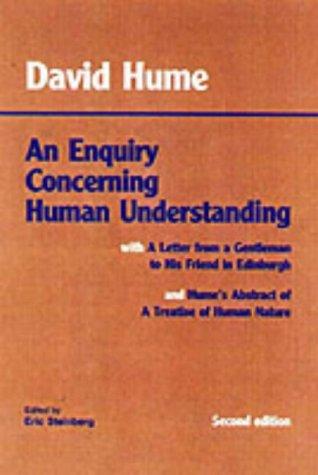
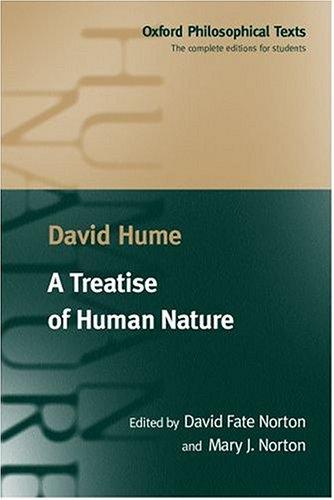
Covers belong to their publishers and are shown so you can recognise the book.
What it holds
These are the questions this philosophy cares about most and the side it leans toward. They are our reading of it, and the same positions the walk uses.
- Experience is the best guide · clearly Where does the most reliable knowledge come from: careful thinking, or what we see, hear and test?
- Certainty is rare · clearly Can we be sure of some things, or can almost everything be doubted?
- No fixed self · clearly Is there a real, lasting you under your thoughts and feelings?
- Only evidence counts · clearly Can faith or trust in a teaching show us truths that evidence cannot?
- All within this world · clearly Is everything that matters found inside this world, or does it point to something beyond it?
- Right and wrong depend on people · leaning Are some moral rules true for everyone, everywhere?
Ideas it speaks to
Short articles on the questions this philosophy answers most firmly.
- Reason or experience · leans toward: Experience is the best guide
- Certainty and doubt · leans toward: Certainty is rare
- The self and personal identity · leans toward: No fixed self
- Faith and evidence · leans toward: Only evidence counts
- Does meaning need something beyond this world · leans toward: All within this world
- Moral relativism and universal morality · leans toward: Right and wrong depend on people
Compared with
- Humean empiricism and skepticism versus Agnosticism
- Humean empiricism and skepticism versus Atheism and naturalism
- Humean empiricism and skepticism versus Conservatism
- Humean empiricism and skepticism versus Rationalism
Thinkers
Related philosophies
Runs parallel to
- Madhyamaka Buddhism · Both take apart the idea of a single unchanging self. (scholars disagree about this link)
Sources we used
- David Hume · Stanford Encyclopedia of Philosophy, read on 7 October 2026
- Hume, David · Internet Encyclopedia of Philosophy, read on 7 October 2026
Where do you stand?
Every philosophy takes sides. Here is one question Humean empiricism and skepticism answers firmly:
Where does the most reliable knowledge come from: careful thinking, or what we see, hear and test?
- Humean empiricism and skepticism leans toward: Experience is the best guide
- The other side: Reason is the best guide
The walk asks about this and the questions around it, two ideas at a time, and shows which philosophies your own answers sit closest to. No account, and your answers stay on your device.