
Immanuel Kant
Modern Ethics · Europe · 1724 to 1804
German philosopher who argued that the mind shapes how we experience the world. He said morality rests on duties every rational being can see.
What it is
Immanuel Kant (1724 to 1804) was a German philosopher who argued that the mind actively shapes the experience we have, so that what we can know is limited to the world as it appears to us, and that morality rests on duties that our own reason gives us. He is often called the central figure of modern philosophy, because he brought together the two great currents before him, rationalism and empiricism, and set the terms for most of what came after.
He was born in 1724 in Königsberg, then a city in East Prussia and now called Kaliningrad, and he died in 1804. His main books are three works called Critiques, on theoretical knowledge, on morality and on judgment, and a short book on the foundations of ethics.
The main ideas
- The mind shapes what we experience. Against the empiricists, who held that the mind is a blank page written on by the world, Kant argued that the mind brings its own forms of experience and categories. They give structure to anything we can experience, such as objects in space and time that have causes. He compared the change to Copernicus: instead of asking how the mind fits the world, ask how the world we experience fits the mind.
- The limits of knowledge. Against the rationalists, who thought pure reason could reveal the nature of a world independent of us, Kant held that knowledge is limited to mathematics and the world of experience. We cannot have a priori knowledge of things as they are in themselves. The view is called transcendental idealism.
- Morality comes from reason. Kant held that the moral law is not imposed from outside. Reason gives it to itself, and being bound by it is a form of freedom, or autonomy. What gives an act moral worth is not its outcome but the motive behind it, which must come from universal principles reason can discover.
- The categorical imperative. The moral law takes the form of a command that binds every rational being whatever they want. It is the basis of the duty-centred approach to ethics known as deontology.
- God, freedom and immortality. Kant argued that the moral law gives us grounds to believe in God, human freedom and immortality, even though theoretical knowledge cannot prove them. So science, morality and faith can all stand on the same foundation of human autonomy.
What it looks like in practice
Picture someone who must decide whether to break a promise because keeping it has become inconvenient. A Kantian does not begin by adding up how much good or harm the choice would do. They ask whether they could will the rule behind it, break a promise whenever it suits me, to be a rule for everyone, and whether they are treating the person who relied on them as someone who can make their own choices. The question is about the principle and the person, before it is about the result.
Books and moments
- Critique of Pure Reason (1781, second edition 1787) sets out transcendental idealism and the limits of knowledge.
- Groundwork for the Metaphysics of Morals (1785) is his short statement of the foundations of ethics.
- Critique of Practical Reason (1788) develops his moral philosophy.
- Critique of the Power of Judgment (1790) is the third Critique, which tries to bring the theoretical and the practical parts of his system together.
Questions and criticism
- One world or two? Readers disagree on what transcendental idealism claims. On one reading there are two kinds of object, appearances and things in themselves. On another there is one world, considered in two ways. The dispute has gone on for a long time.
- Can we really know nothing about things in themselves? If we cannot know them, it is fair to ask how Kant knows that they exist and that they limit what we can know.
- Is a moral law from reason enough? Critics who side with Hume ask whether reason alone can move us to act, and how a duty can bind someone who feels no pull toward it.
Close neighbours
Kant answers Locke, Berkeley and Hume on one side and Descartes and Leibniz on the other, and he took ideas from Hume. In ethics he is the main source of the duty-centred view that stands against utilitarianism, which looks at results. The page on Kantian deontology covers the ethics in more detail.
Written by epchē in our own words, and checked against independent sources on 9 October 2026. The sources are listed below.
Where to start reading
Books by Immanuel Kant or about them, from the easiest way in to the harder ones.
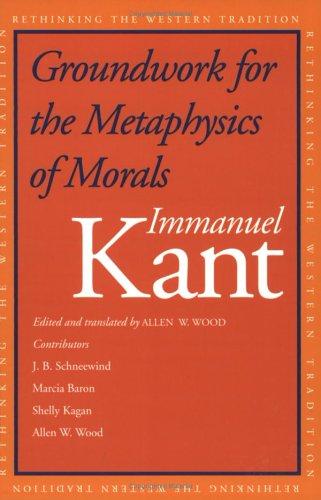
Covers belong to their publishers and are shown so you can recognise the book.
Philosophies they belong to or are close to
Who they connect to
Influenced
- Arthur Schopenhauer · Schopenhauer reworked Kant's split between appearance and thing in itself.
- Christine Korsgaard · She builds her whole account of moral duty on Kant's idea of the self-governing will.
- Edmund Husserl · Husserl's phenomenology builds on Kant's turn to what makes experience possible.
- Ernst Cassirer · He was a leading thinker of the Marburg school that revived Kant, and extended his critique to all forms of culture.
- G. W. F. Hegel · Hegel began from Kant's questions and then criticised his limits.
- Georg Simmel · He asked in Kant's style how society is possible, and answered from forms of interaction. (scholars disagree about this link)
- Gottlob Frege · Frege accepted Kant's view of geometry as known independently of experience while rejecting it for arithmetic.
- Hannah Arendt · Arendt's late lectures on judgement build on Kant's account of taste.
- Henry Sidgwick · Sidgwick took Kant's principle of universal reasons seriously and blended it with his own view.
- Johann Gottfried Herder · He studied under Kant in Konigsberg and was shaped by his early lectures.
- Johann Gottlieb Fichte · Fichte set out to complete Kant's system by deriving it from the free act of the self.
- John McDowell · He built his account of experience on Kant's view that sensing and thinking work together.
- John Rawls · Rawls presents his theory as a Kantian reading of the social contract.
- Jurgen Habermas · Habermas' discourse ethics recasts Kant's universal law as a test in open discussion.
- Karl Popper · Popper described himself as a Kantian who replaced certainty with criticism.
- Kwame Anthony Appiah · His cosmopolitanism echoes Kant's idea that all people belong to one moral community. (scholars disagree about this link)
- Max Weber · His split between facts and values belongs to the neo-Kantian climate of his time. (scholars disagree about this link)
- Nishida Kitaro · Nishida engaged Kant's philosophy at length in his middle period.
- P. F. Strawson · His study of Kant's first Critique shaped his account of the basic frame of thought.
- R. M. Hare · His test of universal rules for moral claims echoes Kant.
- Ralph Waldo Emerson · His circle learned of Kant through English writers and shaped Transcendentalism with it. (scholars disagree about this link)
- T. M. Scanlon · His view that morality rests on mutual justification echoes Kant.
- Tom Regan · He extended Kant's idea that persons must not be treated as mere means to animals. (scholars disagree about this link)
- Wilfrid Sellars · He read Kant closely and took up his view that experience needs concepts.
- Wilhelm Dilthey · He called his work a critique of historical reason, on the model of Kant's critiques.
Influenced by
- David Hume · Kant said Hume woke him from his dogmatic slumber.
- Jean-Jacques Rousseau · Kant said Rousseau taught him to honour ordinary people and freedom.
Reacted against
- Anselm of Canterbury · Kant argued that existence is not a property a thing can have, which undercuts Anselm's argument. (scholars disagree about this link)
Reacted against by
- Johann Gottfried Herder · He later attacked Kant's view that reason can be studied apart from language and history.
- Nel Noddings · She argued that ethics built on rules and duty, in the way of Kant, misses the care at its root.
- Richard Rorty · Rorty rejected Kant's project of finding a fixed framework for knowledge.
Runs parallel to
- Wang Yangming · Both hold that moral guidance is found in the person's own reason or mind. (scholars disagree about this link)
Other Modern Ethics thinkers
- Jeremy Bentham · 1748 to 1832
- John Stuart Mill · 1806 to 1873
- Harriet Taylor Mill · 1807 to 1858
- Henry Sidgwick · 1838 to 1900
- Isaiah Berlin · 1909 to 1997
- Peter Singer · born 1946
- Martha Nussbaum · born 1947
Sources we used
- Immanuel Kant · Stanford Encyclopedia of Philosophy, read on 9 October 2026
- Immanuel Kant: Metaphysics · Internet Encyclopedia of Philosophy, read on 9 October 2026
- Kant's Moral Philosophy · Internet Encyclopedia of Philosophy, read on 9 October 2026