
Jean-Jacques Rousseau
Enlightenment · Europe · 1712 to 1778
Writer from Geneva who held that people are good by nature but bent by unequal societies. He said fair rule rests on the "general will".
What it is
Jean-Jacques Rousseau (1712 to 1778) was a writer and philosopher born in Geneva who held that human beings are good by nature and are corrupted by society, and who tried to describe a community in which people can be free and equal because they obey a will that is their own. He is one of the most influential thinkers of the Enlightenment, though he was also one of its sharpest critics.
His work came to public notice when his essay on the sciences and the arts won a prize from the Academy of Dijon with the unexpected claim that their progress had corrupted virtue and morals. In 1762 he published two books that caused uproar, The Social Contract on politics and Emile on education. Both were condemned and banned in France, and Rousseau fled the country. He died in 1778, and his ideals were later championed by leaders of the French Revolution.
The main ideas
- Good by nature, corrupted by society. In his second major essay, on the origin of inequality, he argues that human beings are basically good by nature but were corrupted by the complex historical events that produced present-day civil society.
- Two kinds of self-love. He separates a natural self-love, amour de soi, which simply cares for one's own life, from amour-propre, a self-love that depends on how others see us. The second, he thought, is what eats away at freedom and authenticity in modern society.
- The general will. In The Social Contract he asks how people can live under laws and still be as free as they were before. His answer rests on the general will, the collective will of the citizens taken as a whole, so that in obeying the law each person obeys a will that is partly their own.
- Education. Emile is his book on how to bring up a child so that the child's independence is encouraged and the worst forms of self-interest do not take root.
What it looks like in practice
Picture a town meeting that must decide whether to build a road through a field. Each person has private interests, and the question is what everyone together should want. Rousseau's idea is that citizens should try to ask not 'what is best for me?' but 'what is best for all of us as members of this community?', and that a law passed in that spirit is one each citizen can recognise as their own. This is an illustration of the idea, not an example he gave.
Books and moments
- Discourse on the Sciences and the Arts brought him fame.
- Discourse on the Origin of Inequality was his second major essay. It develops the idea that people are good by nature and are corrupted by society.
- The Social Contract and Emile (both 1762) are his main works on politics and education.
- The Confessions is his autobiography, written late in life.
Questions and criticism
- What is the general will? Scholars read it in different ways. Is it what the people actually vote for, or what they would choose if they reasoned only about the common good? The answer changes how much freedom the idea leaves each person.
- Are we good by nature? His claim that people are naturally good and corrupted by society is hard to test. It is fair to ask what could count as evidence for or against it.
- Quarrels. He quarrelled with many friends and contemporaries, including Voltaire and David Hume, and the end of his life was marked by suspicion of those around him.
Close neighbours
Rousseau belongs to the same circle of social contract thinkers as Hobbes and Locke, though he drew different conclusions. The pages on Hobbes and Locke show the other main versions of the idea, and the page on liberalism follows how it was used later.
Written by epchē in our own words, and checked against independent sources on 9 October 2026. The sources are listed below.
Where to start reading
Books by Jean-Jacques Rousseau or about them, from the easiest way in to the harder ones.
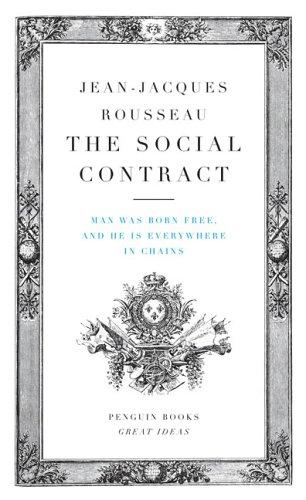
Covers belong to their publishers and are shown so you can recognise the book.
Who they connect to
Influenced
- G. W. F. Hegel · Hegel took up Rousseau's general will while reshaping it.
- Immanuel Kant · Kant said Rousseau taught him to honour ordinary people and freedom.
- John Rawls · Rawls names Rousseau among the contract thinkers whose ideas he carries forward.
- Karl Marx · Marx inherited Rousseau's criticism of inequality created by property.
Influenced by
- John Locke · Rousseau's educational and political writings respond to Locke's.
- Niccolo Machiavelli · Rousseau read his book on princes as a hidden lesson for peoples, and shared his praise of republics. (scholars disagree about this link)
Reacted against
- Thomas Hobbes · Rousseau denied that people in a state of nature are at war and blamed society for inequality.
- Voltaire · Rousseau answered Voltaire's poem on the Lisbon earthquake with a defence of providence and simple living.
Reacted against by
- Mary Wollstonecraft · The Vindication of the Rights of Woman argues against Rousseau's plan for a lesser education for girls.
Other Enlightenment thinkers
- Pierre Bayle · 1647 to 1706
- Montesquieu · 1689 to 1755
- Voltaire · 1694 to 1778
- Julien Offray de La Mettrie · 1709 to 1751
- Denis Diderot · 1713 to 1784
- Baron d'Holbach · 1723 to 1789
- Thomas Paine · 1737 to 1809
- Marquis de Condorcet · 1743 to 1794
- Mary Wollstonecraft · 1759 to 1797
Sources we used
- Jean-Jacques Rousseau · Stanford Encyclopedia of Philosophy, read on 9 October 2026
- Rousseau, Jean-Jacques · Internet Encyclopedia of Philosophy, read on 9 October 2026