
John Rawls
Analytic · North America · 1921 to 2002
American philosopher who argued that fair rules are those people would choose without knowing their own place in society.
What it is
John Rawls (1921 to 2002) was an American political philosopher who revived the social-contract tradition with a theory he called justice as fairness. The theory asks what rules for a society people would agree on if they did not know which place in it they would end up in. He is widely seen as one of the most important political philosophers of the twentieth century, and his first book, A Theory of Justice, changed how English-speaking philosophers think about fairness, equality and the state.
He was born in Baltimore, Maryland, and taught at Cornell and MIT before joining the Harvard faculty in 1962, where he stayed for more than thirty years. A Theory of Justice appeared in 1971. He restated and extended the theory in Political Liberalism (1993) and The Law of Peoples (1999).
The main ideas
- Justice as fairness. Rawls describes a society of free citizens who hold equal basic rights and cooperate within an egalitarian economic system. His subject is the basic structure of society: its main institutions and how they shape everyone's life chances.
- The original position. He built a thought experiment in which people choose the principles of justice without knowing who they will be: rich or poor, strong or weak, of any belief. This ignorance is called the veil of ignorance. It stops anyone from shaping the rules to favour themselves.
- Two principles. First, everyone has equal basic liberties. Second, social and economic inequalities are acceptable only if they come with fair equality of opportunity and work to the greatest benefit of the least advantaged members of society. The second part is called the difference principle.
- Against utilitarianism. Rawls took utilitarianism as his main opponent. He argued that people choosing behind the veil would prefer his principles to the aim of maximising total happiness.
- Reflective equilibrium. A method of testing principles against our more concrete convictions about what is just, adjusting each until they fit.
- Political liberalism. In his later work he accepted that modern societies will always contain many reasonable but conflicting religious and philosophical views. He asked how a society can still agree on a fair political order, and answered with an overlapping consensus and public reason.
- The Law of Peoples. He extended his ideas to relations between nations, aiming at a peaceful and tolerant international order.
What it looks like in practice
Picture a group designing a school system without knowing whether their own child would attend the best school or the worst. Behind the veil, they would be careful about how the worst-off are treated, because any of them might end up there. They might still allow some differences, such as better pay for harder training, but only where the arrangement helps the people at the bottom too. The exercise is a way of checking whether a rule is fair to everyone it affects.
Books and moments
- A Theory of Justice (1971) is his first and most famous book.
- Political Liberalism (1993) recasts the role of political philosophy for societies with many worldviews.
- The Law of Peoples (1999) extends the theory to foreign policy.
Questions and criticism
- Is the difference principle the right test? It has been called both famous and infamous. Whether it asks too much or too little of those who are better off is still argued.
- Is the veil of ignorance neutral? It is fair to ask whether people deprived of knowledge about themselves would choose as Rawls says they would, and whether the choice depends on the temperament he assumes.
- Can an overlapping consensus last? His later theory depends on citizens with different views agreeing on a political basis. It is fair to ask what holds when they stop.
Close neighbours
Rawls belongs to the liberal tradition, and his argument is partly an answer to utilitarianism. The parties in his thought experiment are given a motivation that has a Kantian interpretation. The pages on liberalism, utilitarianism and Kantian deontology describe the views he drew on and argued against.
Written by epchē in our own words, and checked against independent sources on 9 October 2026. The sources are listed below.
Where to start reading
Books by John Rawls or about them, from the easiest way in to the harder ones.
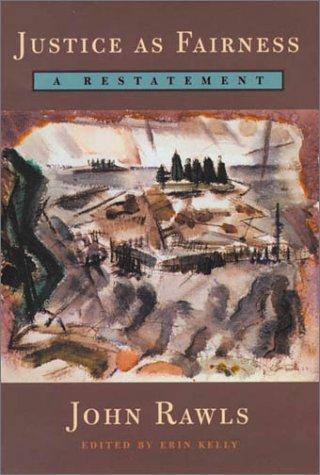
Covers belong to their publishers and are shown so you can recognise the book.
Philosophies they belong to or are close to
Who they connect to
Influenced
- Christine Korsgaard · She studied under Rawls and edited his lectures on moral philosophy.
- Martha Nussbaum · Nussbaum extends Rawls' theory of justice to disability, animals and global questions.
- Ronald Dworkin · He took up Rawls's idea that each person is owed equal concern and respect.
- T. M. Scanlon · He took up Rawls's idea of principles that free and equal people could agree to.
Influenced by
- Immanuel Kant · Rawls presents his theory as a Kantian reading of the social contract.
- Jean-Jacques Rousseau · Rawls names Rousseau among the contract thinkers whose ideas he carries forward.
- John Stuart Mill · Rawls worked out his theory partly through a long argument with the utilitarian tradition of Mill.
- Thomas Hobbes · Rawls places Hobbes at the start of the social contract tradition he revives.
Reacted against by
- Alasdair MacIntyre · MacIntyre denied that a neutral idea of justice can be found apart from traditions.
- Amartya Sen · His book on justice argues that we should compare real societies rather than describe one perfect one, as Rawls did.
- G. A. Cohen · He argued that Rawls' principles allow too much inequality, and that a just society needs an egalitarian ethos.
- Michael Sandel · His first book argues that Rawls's picture of the self as a free chooser leaves out what binds us to others.
Runs parallel to
- Jurgen Habermas · The two held a well-known exchange on the justification of liberal principles.
Other Analytic thinkers
- Gottlob Frege · 1848 to 1925
- Bertrand Russell · 1872 to 1970
- G. E. Moore · 1873 to 1958
- Ludwig Wittgenstein · 1889 to 1951
- Gilbert Ryle · 1900 to 1976
- Karl Popper · 1902 to 1994
- H. L. A. Hart · 1907 to 1992
- W. V. O. Quine · 1908 to 2000
- J. L. Austin · 1911 to 1960
- Wilfrid Sellars · 1912 to 1989
Sources we used
- John Rawls · Stanford Encyclopedia of Philosophy, read on 9 October 2026
- John Rawls · Internet Encyclopedia of Philosophy, read on 9 October 2026