
Ludwig Wittgenstein
Analytic · Europe · 1889 to 1951
Austrian-born philosopher who first tried to set limits on what language can say. Later he held that meaning lies in how words are used in shared practices.
What it is
Ludwig Wittgenstein (1889 to 1951) was an Austrian-born philosopher of logic and language whose early book argued that the limits of language are the limits of what can be said, and whose later work argued that words get their meaning from the ways we use them. He is one of the most influential philosophers of the twentieth century, and some regard him as the most important since Kant. His career is usually divided into an early and a later phase, and the two are strikingly different.
He was born on 26 April 1889 in Vienna, into a wealthy and cultured family. He first studied engineering, in Berlin and then in Manchester, where research in aeronautics drew him to the philosophy of mathematics. On the advice of the logician Gottlob Frege he went to Cambridge to study with Bertrand Russell. The only book he published in his lifetime, the Tractatus Logico-Philosophicus, appeared in the early 1920s. He returned to Cambridge in 1929 and died in 1951.
The main ideas
- The Tractatus: how language pictures the world. The early book applies modern logic to the question of how language relates to the world and to thought. A proposition is a picture of reality. Philosophical problems, on this view, arise from misunderstanding the logic of language. It ends with the famous line: what we cannot speak about we must pass over in silence.
- A critique of his own early work. In his later work, chiefly the Philosophical Investigations, Wittgenstein criticised traditional philosophy, including the high point of it in his own earlier book. The new approach is less technical and is described as anti-systematic.
- Meaning as use. For a large class of cases, the meaning of a word is its use in the language. We understand a word by seeing what people do with it, and not by finding an object it stands for.
- Language-games. He described the activities in which language is woven, such as asking, giving orders and describing, as language-games. Looking at them, he thought, can dissolve philosophical puzzles.
- Rules and private language. His work on what it is to follow a rule, and on whether a language could be private to one person, is still considered important.
What it looks like in practice
Picture two people arguing over what 'game' really means. One insists there must be a single feature all games share. Wittgenstein's advice would be to stop searching for the one hidden essence and to look at how the word is used: the many practices people call games, how they overlap, how they are taught. The puzzle often loses its grip when we describe what we do, and stop assuming what we must be doing.
Books and moments
- Tractatus Logico-Philosophicus (published in English in 1922 with Russell's help) is the only book he published in his lifetime. The logical positivists held it in especially high esteem.
- Philosophical Investigations is the main work of his later phase. It helped to inspire what is called ordinary language philosophy.
Questions and criticism
- One Wittgenstein or two? The standard view divides his work into an early and a later stage. More recent scholars question this, claiming either a unity between the stages or more stages, including a middle and a post-later phase.
- How should he be read? Because his writing is anti-systematic and the project of interpreting it has many sides, it is hard to say what his philosophical method and substance are.
- Is meaning only use? He did not offer a general theory of meaning, only a description that fits a large class of cases, and it is fair to ask whether use is enough to explain meaning.
Close neighbours
Russell was Wittgenstein's teacher, and Frege became something of a friend. His early book was held in high esteem by the logical positivists, and his later work helped to inspire ordinary language philosophy.
Written by epchē in our own words, and checked against independent sources on 9 October 2026. The sources are listed below.
Where to start reading
Books by Ludwig Wittgenstein or about them, from the easiest way in to the harder ones.
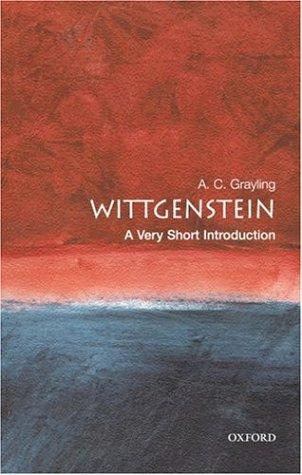
Covers belong to their publishers and are shown so you can recognise the book.
Philosophies they belong to or are close to
Who they connect to
Influenced
- Elizabeth Anscombe · Anscombe was Wittgenstein's student, translated his Investigations and edited his papers.
- Gilbert Ryle · He took up the view that mental words get their meaning from how people use them in life.
- Moritz Schlick · He met Wittgenstein often in the late 1920s and took up his view of meaning.
- Richard Rorty · Rorty drew on the later Wittgenstein's view of language as tools and not a mirror.
- Saul Kripke · His book on rules and private language reads Wittgenstein in a bold and much-discussed way.
Influenced by
- Arthur Schopenhauer · Wittgenstein read Schopenhauer young and kept his view of the limits of the world.
- Bertrand Russell · Wittgenstein studied with Russell at Cambridge and his early work grew out of Russell's logic.
- G. E. Moore · Wittgenstein studied at Cambridge when Moore taught there, and later cited his defence of common sense. (scholars disagree about this link)
- Gottlob Frege · Wittgenstein's Tractatus took its questions about sense and reference from Frege.
Reacted against
- Augustine of Hippo · The Philosophical Investigations opens by criticising an Augustinian picture of how words get meaning.
- Bertrand Russell · Wittgenstein rejected Russell's view of logic and of knowing things by acquaintance.
Reacted against by
- Karl Popper · Popper denied that philosophy is only the clearing up of linguistic confusions.
Runs parallel to
- Nagarjuna · Both use argument to dissolve puzzles and not to build a theory. (scholars disagree about this link)
Other Analytic thinkers
- Gottlob Frege · 1848 to 1925
- Bertrand Russell · 1872 to 1970
- G. E. Moore · 1873 to 1958
- Gilbert Ryle · 1900 to 1976
- Karl Popper · 1902 to 1994
- H. L. A. Hart · 1907 to 1992
- W. V. O. Quine · 1908 to 2000
- J. L. Austin · 1911 to 1960
- Wilfrid Sellars · 1912 to 1989
- H. P. Grice · 1913 to 1988
Sources we used
- Ludwig Wittgenstein · Stanford Encyclopedia of Philosophy, read on 9 October 2026
- Ludwig Wittgenstein · Internet Encyclopedia of Philosophy, read on 9 October 2026