
Arthur Schopenhauer
Modern European · Europe · 1788 to 1860
German philosopher who saw a blind striving beneath the world and looked to compassion and detachment as a way to ease suffering.
What it is
Arthur Schopenhauer (1788 to 1860) was a German philosopher who held that the world, at its core, is not a rational place but a blind, endless striving that he called the will, that life is full of suffering, and that relief comes through art, compassion and a lowering of our desires. He is known as the philosopher of pessimism, though he spent as much effort on the ways out of suffering as on suffering itself.
He was born in 1788 in Danzig, now Gdansk in Poland, the son of a prosperous merchant. He published his main work, The World as Will and Representation, at the end of 1818, and he lived the rest of his life in Frankfurt am Main. He was an atheist who stayed outside the universities, and in his lifetime he never achieved the fame of Fichte and Hegel. Only after his death did his philosophy find a wide audience, especially among artists and writers.
The main ideas
- An irrational world. He argued that the universe at its core is not governed by reason or purpose. He saw himself as developing the work of Kant and Plato, but drew a darker conclusion from it.
- The will. Behind the world we experience lies what Kant called the thing-in-itself. For Schopenhauer it is will, a blind, unconscious force present in all of nature, an endless striving with no end in view.
- Life as suffering. Because the will is never satisfied, daily life, he said, is suffering. This is why he is known as a pessimist.
- Art as relief. The experience of beauty, especially in music, can free us for a while from the pull of desire. He has been called the artist's philosopher, and his ideas have inspired writers, composers and painters.
- Compassion. For him, morality does not come from reason but from the feeling of compassion, which lets a person step out of the standpoint of pure self-interest.
- East and West. He was the first German philosopher to bring Eastern thought into his writing.
What it looks like in practice
Picture someone who has just reached a long-awaited goal and finds the satisfaction gone within a day, replaced by the next wish. Schopenhauer would say that this is not a personal failing but how desire works: it renews itself the moment it is met. His advice would be to ask for less, to spend time with music or a landscape that quiets wanting, and to notice other people's suffering as if it were one's own. This is an illustration of his view, not a quotation.
Books and moments
- The World as Will and Representation (completed in 1818, published with the date 1819) is his main work. It develops the idea of the will and its consequences for knowledge, art and ethics.
Questions and criticism
- Pessimist or not? Often called a thoroughgoing pessimist, he in fact offered ways to overcome the painful side of life. Whether those ways are enough to answer his own pessimism is still argued.
- Is the will a good explanation? To call the thing-in-itself a will goes beyond what Kant allowed. It is fair to ask how he could know that.
- Does compassion rule out self-interest? If morality rests on a feeling, it is fair to ask what happens when the feeling is absent.
Close neighbours
Schopenhauer saw himself as Kant's heir, so the page on Kant is the natural starting point. His influence is clearest on Nietzsche, and on Freud.
Written by epchē in our own words, and checked against independent sources on 9 October 2026. The sources are listed below.
Where to start reading
Books by Arthur Schopenhauer or about them, from the easiest way in to the harder ones.
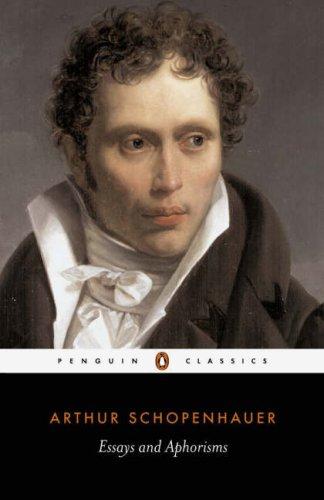
Covers belong to their publishers and are shown so you can recognise the book.
Who they connect to
Influenced
- Friedrich Nietzsche · Nietzsche first admired Schopenhauer, then broke with his pessimism.
- Ludwig Wittgenstein · Wittgenstein read Schopenhauer young and kept his view of the limits of the world.
- Sigmund Freud · Freud found in Schopenhauer an earlier account of drives beneath reason. (scholars disagree about this link)
Influenced by
- Immanuel Kant · Schopenhauer reworked Kant's split between appearance and thing in itself.
- Siddhartha Gautama (the Buddha) · Schopenhauer read Buddhist and Upanishadic texts and ranked them with Plato and Kant. He saw a likeness between his view of suffering and the Four Noble Truths. (scholars disagree about this link)
Reacted against
- G. W. F. Hegel · Schopenhauer despised Hegel's system and lectured in Berlin at the same hours to compete.
- Johann Gottlieb Fichte · Schopenhauer mocked Fichte and the idealists who followed him.
Other Modern European thinkers
- Alexis de Tocqueville · 1805 to 1859
- Thomas Henry Huxley · 1825 to 1895
- Wilhelm Dilthey · 1833 to 1911
- Friedrich Nietzsche · 1844 to 1900
- Sigmund Freud · 1856 to 1939
- Georg Simmel · 1858 to 1918
- Henri Bergson · 1859 to 1941
- Max Weber · 1864 to 1920
- Ernst Cassirer · 1874 to 1945
- Jose Ortega y Gasset · 1883 to 1955
Sources we used
- Arthur Schopenhauer · Stanford Encyclopedia of Philosophy, read on 9 October 2026
- Schopenhauer, Arthur · Internet Encyclopedia of Philosophy, read on 9 October 2026