
Bertrand Russell
Analytic · Europe · 1872 to 1970
British logician and public thinker who used logic to clear up philosophical problems. He argued for careful, questioning inquiry.
What it is
Bertrand Russell (1872 to 1970) was a British philosopher, logician and essayist, and with G. E. Moore he is counted a founder of analytic philosophy. He tried to show that mathematics can be built from logic, found a paradox that shook the foundations of that attempt, and wrote for the public on religion, war and freedom of thought.
He lived to the age of 97 and stayed a prominent public figure for most of that time. He won the Nobel Prize in Literature in 1950 and campaigned against nuclear weapons and against the Vietnam War.
The main ideas
- Logicism. Mathematics can, in some important sense, be reduced to logic. With Alfred North Whitehead he wrote the three-volume Principia Mathematica, whose first volume appeared in 1910, to show how.
- Russell's paradox. Take the set of all sets that are not members of themselves. It is a member of itself only if it is not. The puzzle showed that a natural way of thinking about sets leads to contradiction, and it forced logicians to rebuild the foundations.
- The theory of types. His own repair for the paradox: sort things into levels so that a set cannot be asked about itself in the problem way.
- The theory of descriptions. A way of analysing a phrase like "the present king of France" so that a sentence about something that does not exist can still be meaningful, and false, instead of strange.
- Logical atomism. The world consists of simple logical atoms together with their properties and relations.
- Neutral monism. In his later philosophy, the view that reality is made of one kind of stuff that is neither mental nor physical.
What it looks like in practice
Picture someone who reads a headline about "the winner of the race that was never run" and stops to ask what exactly the phrase claims. Russell's habit was to break such a phrase into its parts, state each claim separately, and see which one fails. This is an illustration of his method, not a saying of Russell.
Books and moments
- The *Principia Mathematica* (first volume 1910, with Whitehead) is the work that did most to establish modern symbolic logic.
- "On Denoting" (1905) is the essay in which he set out the theory of descriptions.
- The Nobel Prize in Literature (1950).
- Why I Am Not a Christian is the best-known title among his writings on religion.
Questions and criticism
- Can mathematics rest on logic alone? He believed so, but the paradox he found showed that the first attempts failed, and whether any repaired system fully succeeds is still discussed.
- Is the theory of descriptions the right account of meaning? Some of his own examples, such as whether names behave like descriptions, remain contested.
- Should a philosopher campaign in public? His stands on religion and war were highly controversial. Whether his public causes and his technical work belong together is a question his readers still ask.
Close neighbours
He refined the logic of Frege and brought it to English-speaking readers, and Wittgenstein is named among those he influenced. The pages on Frege and Wittgenstein set out those links.
Written by epchē in our own words, and checked against independent sources on 9 October 2026. The sources are listed below.
Where to start reading
Books by Bertrand Russell or about them, from the easiest way in to the harder ones.
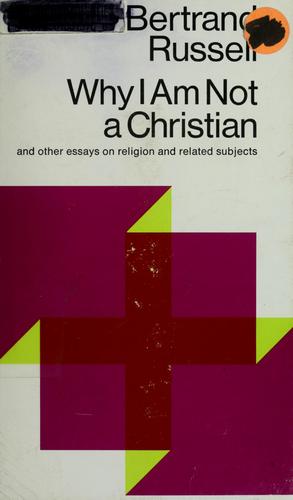
Covers belong to their publishers and are shown so you can recognise the book.
Who they connect to
Influenced
- Ludwig Wittgenstein · Wittgenstein studied with Russell at Cambridge and his early work grew out of Russell's logic.
- Rudolf Carnap · He built his work on Russell's logic and his aim of constructing knowledge from experience.
- W. V. O. Quine · Quine took Russell's theory of descriptions and his logic as a foundation.
Influenced by
- Alfred North Whitehead · He taught Russell at Cambridge and wrote Principia Mathematica with him.
- David Hume · Russell's empiricism follows Hume in tying knowledge to experience.
- Gottlob Frege · Russell built his logic on Frege's, and his famous paradox was first sent to Frege.
- John Stuart Mill · Russell's godfather was Mill and his political liberalism took over Mill's outlook.
Reacted against
- G. W. F. Hegel · Russell led the break from British idealism that followed Hegel's method.
Reacted against by
- Ludwig Wittgenstein · Wittgenstein rejected Russell's view of logic and of knowing things by acquaintance.
- P. F. Strawson · His paper "On Referring" attacked Russell's theory of descriptions.
- Saul Kripke · He attacked the view of names, due to Frege and Russell, that a name stands for a set of descriptions.
Other Analytic thinkers
- Gottlob Frege · 1848 to 1925
- G. E. Moore · 1873 to 1958
- Ludwig Wittgenstein · 1889 to 1951
- Gilbert Ryle · 1900 to 1976
- Karl Popper · 1902 to 1994
- H. L. A. Hart · 1907 to 1992
- W. V. O. Quine · 1908 to 2000
- J. L. Austin · 1911 to 1960
- Wilfrid Sellars · 1912 to 1989
- H. P. Grice · 1913 to 1988
Sources we used
- Bertrand Russell · Stanford Encyclopedia of Philosophy, read on 9 October 2026
- Bertrand Russell · New World Encyclopedia, read on 9 October 2026