
John Stuart Mill
Modern Ethics · Europe · 1806 to 1873
English thinker who defended utilitarianism, the view that the right act does the most good. He said some kinds of happiness are better than others, and he defended individual freedom.
What it is
John Stuart Mill (1806 to 1873) was an English philosopher, economist and reformer who defended utilitarianism, set out the harm principle in his book On Liberty, argued for the equality of women, and made a case for an empiricist view of knowledge. He is often counted among the most influential English-language philosophers of the nineteenth century. His writing covers logic, economics, ethics, politics and religion.
He was born in London and educated at home by his father, James Mill, a friend and ally of the reformer Jeremy Bentham. The education was intense, with Greek at age three and Latin at age eight. In his twenties he turned away from some of his father's views and felt the pull of Romanticism and of historical thinking. For almost thirty-five years he worked for the East India Company, and he also sat for one term in Parliament. He met Harriet Taylor in 1830, and she later became his wife and a close adviser on his work.
The main ideas
- Utilitarianism. In his book Utilitarianism (1861) he defended the view that the right act is the one that does the most good for the happiness of everyone affected. It is the centrepiece of his ethics, and he adapted the form Bentham had given it.
- The harm principle. In On Liberty (1859) he argued that the only purpose for which power can rightly be used against a member of a community, against their will, is to prevent harm to others. A person's own good, physical or moral, is not enough reason. The book also defends freedom of speech and freedom of character and action.
- Equality for women. In The Subjection of Women he compared the legal position of women with that of slaves and argued for equality in marriage and under the law. In Parliament he championed votes for women.
- Knowledge from experience. In his System of Logic (1843) and later works he defended an empiricist and naturalist account of knowledge against what he called the a priori school, which held that some truths are known by intuition independently of experience.
- Enlightenment and Romanticism together. He tried to keep the best of eighteenth-century Enlightenment reason while adding the Romantic emphasis on feeling, imagination and culture, which he had found lacking in his own upbringing.
What it looks like in practice
Picture someone who thinks a neighbour's way of living is foolish and wants a law against it. A Millian question is: does it harm anyone else? If the answer is only that the neighbour is harming themselves, or doing something others dislike, the principle says that power is not justified. The reason is not that the neighbour is wise. It is that people grow by choosing for themselves, and that society learns by seeing different ways of living tried.
Books and moments
- A System of Logic (1843) is his major work on knowledge and method.
- On Liberty (1859) is probably his best-known work. It remains a standard text on freedom of speech and the limits of state power.
- Utilitarianism (1861) is a short book that remains the clearest statement of his ethics.
- The Subjection of Women argues for equality between men and women.
Questions and criticism
- Is his philosophy of knowledge consistent? Readers ask whether his theoretical philosophy holds together or undermines itself, and the question is still argued.
- Is the harm principle clear enough? It is fair to ask what counts as harm to others, and whether harm to oneself ever affects other people.
- Liberty or happiness first? Mill defended liberty on utilitarian grounds. Readers ask whether the two always agree.
Close neighbours
Mill is a follower and a critic of Bentham, and the best-known later voice of classical utilitarianism. His defence of liberty places him in the liberal tradition as well. The pages on utilitarianism and on liberalism describe the views he helped shape.
Written by epchē in our own words, and checked against independent sources on 9 October 2026. The sources are listed below.
Where to start reading
Books by John Stuart Mill or about them, from the easiest way in to the harder ones.
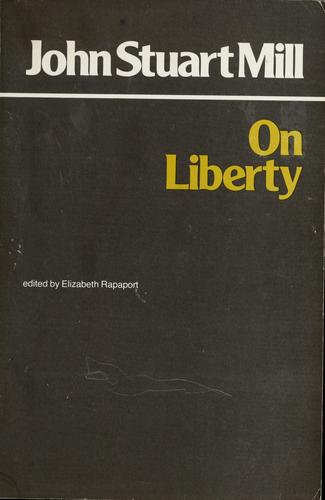
- Utilitarianism John Stuart Mill
Covers belong to their publishers and are shown so you can recognise the book.
Philosophies they belong to or are close to
Who they connect to
Influenced
- Bertrand Russell · Russell's godfather was Mill and his political liberalism took over Mill's outlook.
- Henry Sidgwick · Sidgwick set out to give Mill's utilitarianism a firmer basis.
- Isaiah Berlin · He defended Mill's view that freedom of choice is a good in itself.
- John Rawls · Rawls worked out his theory partly through a long argument with the utilitarian tradition of Mill.
- R. M. Hare · He argued that universal rules lead toward weighing all interests, as Mill's utilitarianism does.
Influenced by
- Adam Smith · Mill's economics extends the classical tradition of Smith.
- Alexis de Tocqueville · Mill reviewed his book and took up its warnings about the majority.
- Auguste Comte · Mill admired Comte's positive method, though he rejected his plan for a new religion of humanity.
- Harriet Taylor Mill · Mill said that his work on liberty and on the subjection of women owed much to her.
- Jeremy Bentham · Mill was raised on Bentham's ideas and then refined them.
- Mary Wollstonecraft · Mill's argument for women's equality echoes Wollstonecraft. (scholars disagree about this link)
Reacted against by
- Gottlob Frege · Frege's Foundations of Arithmetic attacked Mill's view that numbers come from experience.
Other Modern Ethics thinkers
- Immanuel Kant · 1724 to 1804
- Jeremy Bentham · 1748 to 1832
- Harriet Taylor Mill · 1807 to 1858
- Henry Sidgwick · 1838 to 1900
- Isaiah Berlin · 1909 to 1997
- Peter Singer · born 1946
- Martha Nussbaum · born 1947
Sources we used
- John Stuart Mill · Stanford Encyclopedia of Philosophy, read on 9 October 2026
- John Stuart Mill · Internet Encyclopedia of Philosophy, read on 9 October 2026