
Nagarjuna
Buddhist · South Asia · 150 to 250
Indian Buddhist thinker who argued that nothing has a fixed nature of its own, and founded the Middle Way school.
What it is
Nagarjuna (about 150 to 250 CE) was an Indian Buddhist philosopher, the founder of the Madhyamaka or middle way school, who argued that nothing has a fixed nature of its own, a view he called emptiness. He is regarded as the most important Buddhist philosopher after the Buddha himself, and Tibetan and East Asian Buddhist traditions have called him the second Buddha.
His writings became a point of reference for Buddhist thinkers in India for a thousand years after his death, and in Tibet, China, Japan and other Asian countries as Buddhism spread. His best-known work is the Fundamental Verses on the Middle Way, a set of short verses that take apart some of the ideas people rely on most when they think about the world.
The main ideas
- Emptiness. Nagarjuna held that things are empty of svabhāva, a word often translated as own-nature or intrinsic nature, meaning a fixed core that makes a thing what it is independently of everything else. This is not a claim that nothing exists. It is a claim about how things exist.
- Dependent origination. Things come to be in dependence on causes and conditions, and this is the reason they have no independent nature. Emptiness and dependent origination are two ways of describing the same fact.
- Against stable substances. He criticised the assumptions of stable substances, of causation as a simple one-way movement, and of a fixed identity or self.
- The middle way. His position avoids two extremes. Things are not ultimately real in themselves, and they are not nothing.
- The fourfold denial. He used a pattern of reasoning called the catuṣkoṭi, which denies each of four possible positions on a question, to show that a question rests on a faulty assumption.
- Two levels of truth. He discussed how ordinary, conventional descriptions of the world relate to the deeper truth of emptiness.
What it looks like in practice
Picture a person who is sure that their anger is simply who they are. Nagarjuna's approach invites them to look for the fixed thing called 'my anger' and to notice that it is always found only in a moment, with a cause, a trigger and a response, and never as a separate item. The point is not to deny the anger but to see that it depends on conditions and so can change. This is an illustration, not a passage from the Verses.
Books and moments
- Fundamental Verses on the Middle Way is his best-known work and the foundation of the Madhyamaka school.
Questions and criticism
- Is it nihilism? Critics have said that a view which denies fixed natures leaves nothing in the world. Defenders say emptiness is the way things actually exist.
- Can reasoning end all views? He used argument to undo claims, and it is fair to ask whether his own position avoids being a view that can be undone.
- One thinker or many? The Verses are short and compressed, and readers have found many different meanings in them.
Close neighbours
The page on Madhyamaka describes the school he founded. The page on the Buddha covers the figure after whom he is called the second Buddha.
Written by epchē in our own words, and checked against independent sources on 9 October 2026. The sources are listed below.
Where to start reading
Books by Nagarjuna or about them, from the easiest way in to the harder ones.
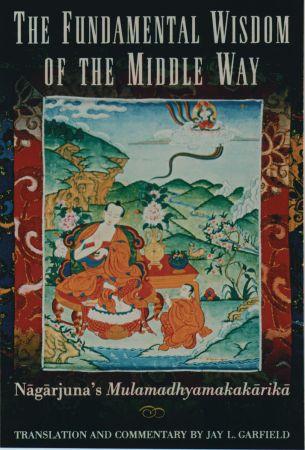
Covers belong to their publishers and are shown so you can recognise the book.
Philosophies they belong to or are close to
Who they connect to
Influenced
- Candrakirti · Candrakirti wrote the main commentary defending Nagarjuna's method.
- Dogen · Zen drew on the Perfection of Wisdom tradition that Nagarjuna interpreted, so his influence on Dogen is indirect. (scholars disagree about this link)
- Kukai · The Shingon lineage that Kukai brought to Japan counts Nagarjuna among its patriarchs. (scholars disagree about this link)
- Shinran · He names Nagarjuna first among the seven patriarchs of his tradition.
- Wonhyo · He wrote commentaries on texts of the Middle Way and mind-only schools and tried to reconcile them. (scholars disagree about this link)
Runs parallel to
- Ludwig Wittgenstein · Both use argument to dissolve puzzles and not to build a theory. (scholars disagree about this link)
- Vasubandhu · Vasubandhu's Yogacara and Nagarjuna's Madhyamaka are the two great Mahayana traditions, and each defines itself partly against the other.
Other Buddhist thinkers
- Siddhartha Gautama (the Buddha) · 480 to 400 BCE
- Asanga · 300 to 370
- Vasubandhu · 350 to 430
- Dignaga · 480 to 540
- Candrakirti · 600 to 650
- Dharmakirti · 600 to 660
- Wonhyo · 617 to 686