
Alasdair MacIntyre
Analytic · North America · 1929 to 2025
Scottish-born philosopher who argued that virtues make sense only within traditions and shared practices, and that modern ethics lost this ground.
What it is
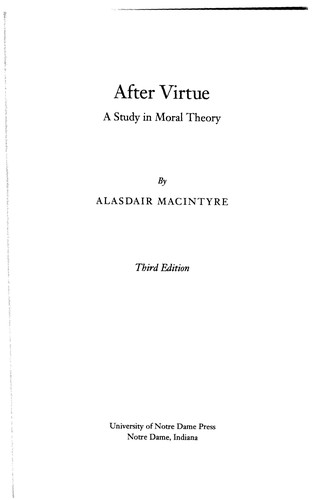
Alasdair MacIntyre (1929 to 2025) was a Scottish-born moral and political philosopher who began as a Marxist, argued that modern moral language has lost its footing, and renewed the Aristotelian tradition of the virtues. His best-known book, After Virtue, appeared in 1981 and made the case that ethics should be understood through character, shared practices and the traditions that carry them. His work is important to the revival of virtue ethics and to discussions of communities and politics.
He was born in Scotland and worked in Britain and, from 1970, in the United States. In his early career he worked in a Marxist framework and tried to build a Marxist ethics that could justify the moral condemnation of Stalinism. That project led him to reject Marxism and what he called modern liberal individualism, and to propose Aristotle's ethics as a better basis. He died in 2025, aged 96.
The main ideas
- From Marxism to Aristotle. MacIntyre moved from a Marxist outlook to a revival of Aristotle's account of the good, in which actions are understood by the ends they aim at and a good life is lived in community.
- A diagnosis of modern morality. In After Virtue (1981) he argued that modern moral culture has become a culture of emotivism, in which moral language is used to express and manipulate attitudes, so that moral rhetoric about objectivity covers arbitrary choices. He wanted to reclaim a more modest but real moral rationality.
- Traditions and reason. In Whose Justice? Which Rationality? (1988) and Three Rival Versions of Moral Enquiry (1990) he asked what role traditions play in judgments about truth and falsity. His claim is that reasoning always takes place inside a tradition.
- We depend on others. In Dependent Rational Animals (1999) he looked at the social needs and debts of human beings and at how a community forms a person who can reason independently.
What it looks like in practice
Picture someone who must decide whether to speak up when a colleague is treated unfairly. A MacIntyre-style question is not only 'what rule applies?' but 'what kind of person am I becoming, and in which community?' Acting well, on this view, means acting as a good member of a community would, with the character that community has tried to form in its members.
Books and moments
- After Virtue (1981) is his best-known book.
- Whose Justice? Which Rationality? (1988) and Three Rival Versions of Moral Enquiry (1990) develop the role of traditions.
- Dependent Rational Animals (1999) takes up the need for community in forming a rational agent.
- His Thomism. From 1984 he identified himself as a Thomist, a follower of Thomas Aquinas, although some Thomists question that description.
Questions and criticism
- Is modern morality really in disarray? It is fair to ask whether his diagnosis of modern moral culture is a good picture or an exaggeration.
- Which tradition? If reason always works inside a tradition, it is fair to ask how people from different traditions can judge between them.
- Which label fits? MacIntyre denied that he belonged to either the virtue ethics school or the communitarian one, though his work is important to both.
Close neighbours
MacIntyre revived Aristotle's ethics and identified himself as a Thomist, so Aristotle and Aquinas are his closest neighbours. He began from Marxism and left it behind. The page on Aristotelian virtue ethics describes the tradition he renewed.
Written by epchē in our own words, and checked against independent sources on 9 October 2026. The sources are listed below.
Where to start reading
Books by Alasdair MacIntyre or about them, from the easiest way in to the harder ones.
Covers belong to their publishers and are shown so you can recognise the book.
Philosophies they belong to or are close to
Who they connect to
Influenced
- Michael Sandel · He took up the view that ethics must start from shared traditions and practices. (scholars disagree about this link)
Influenced by
- Aristotle · MacIntyre rebuilds ethics on an Aristotelian account of the virtues and human ends.
- Elizabeth Anscombe · MacIntyre's After Virtue starts from the diagnosis that Anscombe gave.
- Karl Marx · MacIntyre was a Marxist in his early career and kept parts of the critique of capitalism.
- Thomas Aquinas · MacIntyre later described himself as a Thomist.
Reacted against
- Friedrich Nietzsche · MacIntyre poses the choice as Nietzsche or Aristotle and sides with Aristotle.
- John Rawls · MacIntyre denied that a neutral idea of justice can be found apart from traditions.
Other Analytic thinkers
- Gottlob Frege · 1848 to 1925
- Bertrand Russell · 1872 to 1970
- G. E. Moore · 1873 to 1958
- Ludwig Wittgenstein · 1889 to 1951
- Gilbert Ryle · 1900 to 1976
- Karl Popper · 1902 to 1994
- H. L. A. Hart · 1907 to 1992
- W. V. O. Quine · 1908 to 2000
- J. L. Austin · 1911 to 1960
- Wilfrid Sellars · 1912 to 1989
Sources we used
- Alasdair MacIntyre · Internet Encyclopedia of Philosophy, read on 9 October 2026
- Alasdair MacIntyre · Wikipedia, read on 9 October 2026