
Confucius
Confucian · East Asia · 551 to 479 BCE
Chinese teacher who held that a good society grows from cultivated people who honour their relationships and roles.
What it is
Confucius (traditionally 551 to 479 BCE) was a Chinese teacher and thinker, known in China as Master Kong, whose sayings, collected in a book called the Analects, shaped a tradition built on ritual, family duty, personal virtue and moral leadership. His influence on East Asian thought and society has been immense, and he is often described as the most significant thinker in East Asian history.
Very little is known for certain about the man himself. The sources for his life were written decades to centuries after he died, and the Analects, our main source, is a collection of sayings and dialogues whose origins scholars still debate. Over the centuries he has been portrayed as a teacher, an adviser, an editor, a reformer, even a prophet. For that reason it is safest to speak of the themes that run through the early sources and are linked to his name.
The main ideas
- Ritual as a way of living together. Ritual propriety, in Chinese li, covers the forms of conduct through which a family, a community and a state keep harmony. Good forms shape how people feel and act toward one another.
- Cultivating virtue. His ethics is about growing good character over a lifetime, with benevolence or humaneness, ren, as a central quality.
- The exemplary person. The junzi, literally 'lord's son' and often translated 'gentleman', is the ideal of developed character that others learn from. He is contrasted with the lesser person who has not done that work.
- Family first. Reverence for parents and elders, xiao, is the root of social harmony. The family is the first place where moral habits are learned, and it is the model for how a state should be run.
What it looks like in practice
Picture a manager who keeps losing the respect of the team despite giving clear orders. Following this tradition, the question would turn from rules to conduct: does she herself arrive on time, treat each person with courtesy, and keep her word? The idea is that people learn how to behave more from what they see than from what they are told. This is an illustration, not a saying of Confucius.
Books and moments
- The Analects (in Chinese, Lunyu) collects sayings and short dialogues about Confucius and his disciples. It is the traditional source for his teaching.
- Mencius and Xunzi were thinkers of the following centuries who developed his ideas, though neither knew him.
- Neo-Confucianism was a later revival, after Buddhism had become established in China, that read the Analects in a new framework.
Questions and criticism
- Which Confucius? The early sources are limited and differ, and interpreters in later centuries have praised or attacked parts of his teaching to suit their own purposes. It is fair to ask how much of what is called Confucian goes back to him.
- Ritual or conscience? Critics have asked whether stressing ritual and rank can protect those who hold power, and what a person should do when the proper forms and personal conscience pull apart.
- Family first or everyone alike? Putting the family at the base of morality can seem to favour one's own over strangers. Readers disagree about how far the tradition can reach beyond it.
Close neighbours
The page on Confucianism describes the tradition that bears his name and its later developments.
Written by epchē in our own words, and checked against independent sources on 9 October 2026. The sources are listed below.
Where to start reading
Books by Confucius or about them, from the easiest way in to the harder ones.
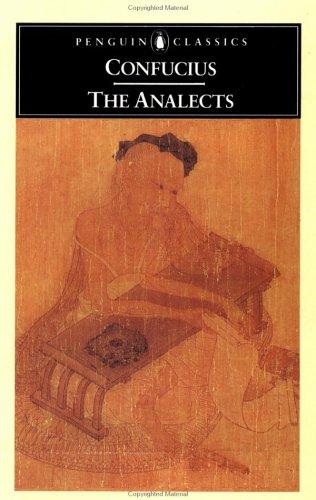
Covers belong to their publishers and are shown so you can recognise the book.
Philosophies they belong to or are close to
Who they connect to
Influenced
- Dong Zhongshu · He built a state teaching on the Confucian classics.
- Kang Youwei · He rebuilt his teaching on a new reading of Confucius as a champion of change.
- Mencius · Mencius took up and developed Confucius' ideas.
- Voltaire · Voltaire praised Confucian ethics as a model of morals without revelation.
- Xunzi · Xunzi defended Confucian ritual while rejecting Mencius' view of nature.
Reacted against by
- Fukuzawa Yukichi · He criticised the old Confucian ethic of rank and loyalty, and urged each person to stand independent.
- Motoori Norinaga · He attacked what he called the Chinese mind, meaning the Confucian way of judging life by rules, and urged a return to native feeling.
Runs parallel to
- Socrates · Both were teachers who worked through conversation and made the examined life the centre of their teaching. (scholars disagree about this link)
Other Confucian thinkers
- Mencius · 372 to 289 BCE
- Xunzi · 310 to 235 BCE
- Dong Zhongshu · 179 to 104 BCE
- Zhu Xi · 1130 to 1200
- Wang Yangming · 1472 to 1529
- Yi Hwang · 1501 to 1570
- Yi I · 1536 to 1584
- Kang Youwei · 1858 to 1927