
Mencius
Confucian · East Asia · 372 to 289 BCE
Confucian thinker who held that human nature has inborn moral sprouts that education can grow.
What it is
Mencius was a Chinese Confucian thinker of the fourth century BCE, best known for the claim that human nature is good and for the image of moral sprouts that education and effort grow into the virtues. In China he is called Master Meng, Mengzi, and he is known as the Second Sage of Confucianism, second in importance only to Confucius himself.
He lived in the Warring States period, in the second half of the Zhou dynasty, a time of great social and intellectual ferment. He travelled to meet the rulers of his day and advised them to govern with benevolence, and the book that carries his name records many of these conversations. In many ways he played a role like that of an interpreter of the master: he explained Confucius to later ages while giving the ideas his own philosophical stamp.
The main ideas
- Human nature is good. All human beings share an innate goodness. It can be cultivated through education and self-discipline, or squandered through neglect and bad influences.
- Sprouts. Our natural feelings are the sprouts of the four cardinal virtues. A sprout is a beginning, not a finished tree, and it needs care to grow.
- The child at the well. To show the sprouts, he asks us to imagine seeing a child about to fall into a well. Anyone would feel alarm and compassion, he says, before thinking of any reward or reputation.
- Four feelings, four virtues. Compassion becomes benevolence, shame becomes rightness, deference becomes ritual propriety, and the sense of approval and disapproval becomes wisdom.
- Extending the heart. Ethical cultivation means widening the love and respect first felt toward one's family until it reaches others.
- Government by benevolence. He advised rulers to govern with benevolence and to care for the people.
What it looks like in practice
Picture someone who sees a stranger drop a bag of groceries on a busy street and steps in to help before thinking about it. Mencius would point to that quick pull as the sprout of benevolence, and say that the task of a life is to notice such moments, trust them and build on them so that they become steady habits. This is an illustration of his idea, not a story from the book.
Books and moments
- The Mencius is the book of his conversations with rulers and disciples.
- The child at the well is its most famous passage.
- Xunzi's reply, in his essay "Human Nature Is Bad", attacks Mencius by name.
Questions and criticism
- Is human nature good? Xunzi, a later Confucian, argued the opposite. Whether the two really disagree, or only frame the question differently, is still discussed.
- Do the sprouts prove it? A feeling of alarm for a child shows a quick response. It is fair to ask whether that shows a goodness built into human nature.
- Where do bad people come from? If goodness is natural, it is fair to ask what explains cruelty, and he points to neglect and bad influences.
Close neighbours
The page on Confucius covers the master he explained, and the page on Confucianism describes the whole tradition. Xunzi, his later opponent, has a page of his own.
Written by epchē in our own words, and checked against independent sources on 9 October 2026. The sources are listed below.
Where to start reading
Books by Mencius or about them, from the easiest way in to the harder ones.
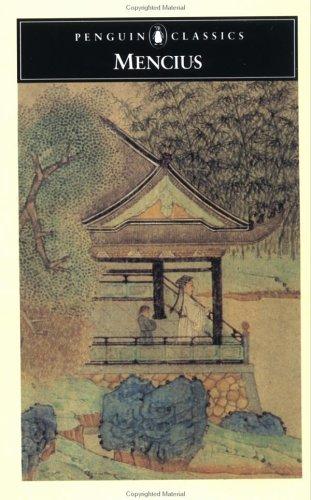
Covers belong to their publishers and are shown so you can recognise the book.
Philosophies they belong to or are close to
Who they connect to
Influenced
- Wang Yangming · Wang Yangming's innate moral knowledge extends Mencius' idea of inborn moral sprouts.
Influenced by
- Confucius · Mencius took up and developed Confucius' ideas.
Reacted against
- Mozi · Mencius attacked Mozi's impartial care as denying the special claims of family.
Reacted against by
- Xunzi · Xunzi held that human nature is bad, not good.
Other Confucian thinkers
- Confucius · 551 to 479 BCE
- Xunzi · 310 to 235 BCE
- Dong Zhongshu · 179 to 104 BCE
- Zhu Xi · 1130 to 1200
- Wang Yangming · 1472 to 1529
- Yi Hwang · 1501 to 1570
- Yi I · 1536 to 1584
- Kang Youwei · 1858 to 1927
Sources we used
- Mencius · Stanford Encyclopedia of Philosophy, read on 9 October 2026
- Mencius (Mengzi) · Internet Encyclopedia of Philosophy, read on 9 October 2026