
Friedrich Hayek
Modern European · Europe · 1899 to 1992
Austrian-born economist and philosopher. He argued that knowledge is spread across society, so markets and spontaneous order work better than central planning.
What it is
Friedrich Hayek (1899 to 1992) was an Austrian-born economist and philosopher. He was born in Vienna and taught in London, at the University of Chicago and at Freiburg, and he won the Nobel Prize in Economics in 1974.
He is known for an argument about knowledge and society. People can only act on what they know, he said, and the knowledge a society needs is spread among many people. Because of that, he doubted that any central authority could hold it all and run an economy well.
The main ideas
- Spontaneous order. This idea stood at the centre of his work. Some orderly structures are the result of the actions of many people but of no one's design.
- Prices carry knowledge. He held that price signals are the means by which each person making an economic decision can pass on knowledge that is spread out and often hard to put into words. In this way prices let people who have never met adjust to each other.
- The limits of central planning. The knowledge needed to run an economy is spread across many people and is never gathered in one place, which is why he doubted that central planning could solve the problem.
- The rule of law. He saw the central role of the state as maintaining the rule of law, with as little arbitrary intervention as possible.
- Doubt about social justice. He disapproved of the notion of social justice and called it a mirage and an empty phrase with no determinable content. By it he meant distributive justice, the idea that outcomes should be judged and steered as just or unjust.
- A floor, in principle. For all that, he accepted that a government might assure everyone a minimum income, a floor below which nobody need fall.
What it looks like in practice
Imagine a city where a baker raises the price of bread after a flour shortage nobody has announced. A person following Hayek would point out that the rise tells every baker and every buyer to use less flour, without anyone needing to know why flour is scarce. This is an illustration of his argument about prices, not an episode he described.
Books and moments
- The Road to Serfdom (1944).
- The Use of Knowledge in Society (1945), the article in which he set out how prices pass on knowledge.
- The Constitution of Liberty (1960).
- Law, Legislation and Liberty, in three volumes.
- The Fatal Conceit (1988), with the subtitle on the errors of socialism.
Questions and criticism
- A tension in the safety net. The philosopher Adam Tebble argues that Hayek's allowing a state-provided minimum sits uneasily with his case for private property, free markets and spontaneous order.
- Is social justice empty? He doubted the notion, yet people do judge outcomes as fair or unfair. It is fair to ask whether a theory should explain that habit of judging.
- Order that no one designed. The same argument that favours markets could be used for habits and customs that were also never planned. It is fair to ask which of them deserve to be kept.
Close neighbours
The page on Robert Nozick sets out a related argument for a limited state. The pages on Adam Smith and Karl Marx belong to older debates about markets and planning.
Written by epchē in our own words, and checked against independent sources on 29 October 2026. The sources are listed below.
Where to start reading
Books by Friedrich Hayek or about them, from the easiest way in to the harder ones.
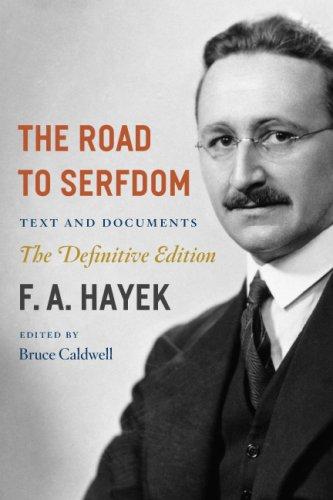
Covers belong to their publishers and are shown so you can recognise the book.
Philosophies they belong to or are close to
Other Modern European thinkers
- Arthur Schopenhauer · 1788 to 1860
- Alexis de Tocqueville · 1805 to 1859
- Thomas Henry Huxley · 1825 to 1895
- Wilhelm Dilthey · 1833 to 1911
- Friedrich Nietzsche · 1844 to 1900
- Sigmund Freud · 1856 to 1939
- Georg Simmel · 1858 to 1918
- Henri Bergson · 1859 to 1941
- Max Weber · 1864 to 1920
- Ernst Cassirer · 1874 to 1945
Sources we used
- Friedrich Hayek · Stanford Encyclopedia of Philosophy, read on 29 October 2026
- Friedrich Hayek · Wikipedia, read on 29 October 2026
Read more elsewhere
- Stanford Encyclopedia of Philosophy · long and detailed, written by specialists