
Alvin Plantinga
Analytic · North America · born 1932
American philosopher and Christian thinker. He defended belief in God without needing proof, and argued that naturalism undermines trust in our own reasoning.
What it is
Alvin Plantinga is an American philosopher and a Christian, who has worked mainly on the philosophy of religion and on the theory of knowledge. He is a leading figure in reformed epistemology, the view that belief in God can be rational even without arguments or evidence for God's existence.
He taught for many years at Calvin College, and he is a prominent Christian philosopher. The questions he asks are plain. What does it take for a belief to be reasonable, and does belief in God have to be argued for before it counts?
The main ideas
- Belief in God can be properly basic. Some beliefs, such as that other people exist or that the past is real, are held without an argument and are still reasonable. He argued that belief in God can belong with them.
- Warrant. He used the word warrant for whatever turns a true belief into knowledge. In his account, one condition is that the faculties that form the belief are working properly.
- Religious belief and warrant. He applied that account to Christian belief, and argued that Christian belief can have warrant, and that you cannot show it lacks warrant without first assuming it is false.
- The ontological argument. He gave a modern form of the old ontological argument for God, built on the idea of necessary existence.
- Evil. He wrote on the problem of evil, which presses the question of how God's goodness and power fit with the existence of evil in the world.
What it looks like in practice
Picture someone who is asked why they believe in God, and who has no argument ready. A critic says that a belief without evidence is irresponsible. Following Plantinga, the believer replies that nobody has an argument for many of their most secure beliefs, such as that the past is real or that other minds exist, and that demanding evidence for each of them would leave almost nothing standing. The example is an illustration of his reasoning, not a passage from his books.
Books and moments
- God and Other Minds (1967) compares belief in God with belief that other people have minds.
- Faith and Rationality (1983) is a collection that he edited with Nicholas Wolterstorff.
- Warrant and Proper Function sets out his account of what makes a belief knowledge, and Warranted Christian Belief (2000) applies it to Christianity.
- Science and Religion: Are They Compatible? is a book that records a discussion he held with the philosopher Daniel Dennett.
Questions and criticism
- Does he beat the demand for evidence? It is fair to ask whether showing that older arguments for demanding evidence fail also shows that the demand itself is wrong.
- Who decides what is properly basic? Different communities will list different beliefs as basic. It is fair to ask who decides, and whether the choice is arbitrary.
Close neighbours
The pages on Daniel Dennett and J. L. Mackie show thinkers who argued against belief in God, and the schools of theism and atheism set out the larger positions. The page on Anselm of Canterbury covers the old argument from which the ontological argument comes.
Written by epchē in our own words, and checked against independent sources on 29 October 2026. The sources are listed below.
Where to start reading
Books by Alvin Plantinga or about them, from the easiest way in to the harder ones.
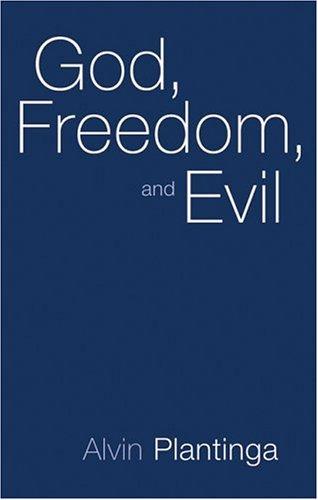
Covers belong to their publishers and are shown so you can recognise the book.
Philosophies they belong to or are close to
Other Analytic thinkers
- Gottlob Frege · 1848 to 1925
- Bertrand Russell · 1872 to 1970
- G. E. Moore · 1873 to 1958
- Ludwig Wittgenstein · 1889 to 1951
- Gilbert Ryle · 1900 to 1976
- Karl Popper · 1902 to 1994
- H. L. A. Hart · 1907 to 1992
- W. V. O. Quine · 1908 to 2000
- J. L. Austin · 1911 to 1960
- Wilfrid Sellars · 1912 to 1989
Sources we used
- Reformed Epistemology · Internet Encyclopedia of Philosophy, read on 29 October 2026
- Alvin Plantinga · Wikipedia, read on 29 October 2026
- Alvin Plantinga · Encyclopaedia Britannica, read on 29 October 2026
- Atheism and Agnosticism · Stanford Encyclopedia of Philosophy, read on 29 October 2026