
Zhuangzi
Daoist · East Asia · 369 to 286 BCE
Chinese thinker who used stories and paradox to question fixed points of view. He praised living freely and naturally.
What it is
Zhuangzi, or Master Zhuang, was a Chinese Daoist thinker of the late fourth century BCE, and the book that bears his name is both a philosophical masterpiece and a work of literature, famous for its stories and humour and for its doubt about fixed viewpoints. He is the pivotal figure in classical philosophical Daoism, and the Zhuangzi and the Laozi are the two earliest texts of that tradition.
He was born in a village called Meng, in the state of Song. The book is a compilation of his writings and those of others, and is divided into three parts: the Inner Chapters, numbered 1 to 7, which tradition ascribes to him; the Outer Chapters, 8 to 22; and the Miscellaneous Chapters. The text we have was edited by Guo Xiang, who died in 312 CE.
The main ideas
- Wandering free. The first chapter is about free and easy wandering, moving through life without being bound by fixed aims and standards.
- Doubt about viewpoints. The text points out that judgments are made from different perspectives. Chapter 2 takes up this theme.
- Skill as a model. The text shows a respect for simple, natural skills and for living simply and naturally.
- The use of the useless. A famous story tells of a tree that survives because it is useless to humans, and thereby keeps its life.
- Spontaneity and wu-wei. The text speaks of an effortless flow along a natural path, and of acting without interference.
- A rival voice. In the text, his usual discussant is Hui Shi, a linguistic relativist, with whom he argues.
What it looks like in practice
Picture someone who is caught up in a quarrel about which of two ways of doing a task is right, and who notices that each side can make its case from where it stands. A reader of the Zhuangzi would not ask them to pick a winner. The book invites them to step back, to see how the quarrel looks from the other side, and perhaps to laugh a little at the stakes. This is an illustration of the spirit of the book, not a passage from it.
Books and moments
- The Inner Chapters are the seven chapters traditionally attributed to Master Zhuang himself.
- Free and easy wandering is the title idea of the first chapter.
- Guo Xiang's edition is the version of the text that has come down to us.
Questions and criticism
- Who wrote it? The book is a compilation, and readers doubt that all of it is by Zhuangzi. It is fair to ask which parts speak for him.
- Follower of Laozi? The Zhuangzi and the Laozi are the two earliest Daoist texts, and it is fair to ask how far the first builds on the second.
- Does doubt lead anywhere? If every viewpoint is partial, it is fair to ask how one can live and choose, and the book's answer lies in skill and spontaneity.
Close neighbours
The page on Laozi covers the other early Daoist text, and the page on Daoism describes the tradition that grew from both.
Written by epchē in our own words, and checked against independent sources on 9 October 2026. The sources are listed below.
Where to start reading
Books by Zhuangzi or about them, from the easiest way in to the harder ones.
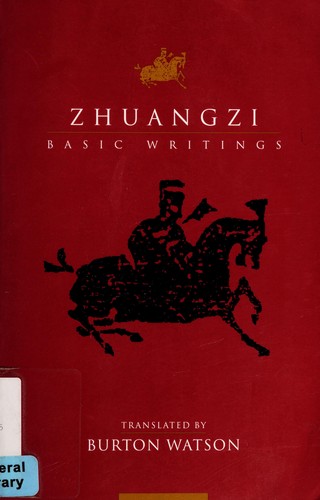
Covers belong to their publishers and are shown so you can recognise the book.
Philosophies they belong to or are close to
Who they connect to
Influenced by
- Laozi · Zhuangzi developed the Daoist themes with humour and paradox.
Other Daoist thinkers
Sources we used
- Zhuangzi · Stanford Encyclopedia of Philosophy, read on 9 October 2026
- Zhuangzi (Chuang-Tzu) · Internet Encyclopedia of Philosophy, read on 9 October 2026