
Michel Foucault
Modern European · Europe · 1926 to 1984
French thinker who traced how ideas of madness, crime and sexuality are tied to power and to the ways people are governed.
What it is
Michel Foucault (1926 to 1984) was a French philosopher and historian who studied how madness, medicine, prisons and sexuality were shaped by systems of knowledge and power, and who developed two methods for doing it, which he called archaeology and genealogy. He is counted among the major figures of twentieth-century thought, and his books are read across philosophy, history, sociology and many other fields.
He was born in 1926 in Poitiers, France, studied at the École Normale Supérieure in Paris, and later held a chair at the Collège de France until his death in 1984. Each of his major books is a critical history, asking how a way of thinking that now seems natural came to be, and what it did to the people it described.
The main ideas
- Histories that question reason. His History of Madness asked how the modern idea of mental illness arose. The Birth of the Clinic did the same for modern medicine and The Order of Things for the modern human sciences.
- Archaeology. In The Archaeology of Knowledge he set out the method he had used. It treats the ways a period speaks and knows, such as its medical discourse, as a subject of study in their own right. His word for the deep framework of knowledge in an age was the episteme.
- Genealogy. Later he moved to genealogy, a method he took from Nietzsche. It traces how practices and beliefs came about through struggles and changes of power, and not through a steady progress of reason.
- Discipline and Punish. The 1975 book on the modern prison argues that it does not only punish but sorts people into types and watches them. Bentham's Panopticon, a prison designed so that the inmates can always be seen, is its central image.
- The History of Sexuality. He began a history of modern sexuality with The Will to Knowledge.
- Government. In his lectures at the Collège de France he introduced ideas about government, population and biopolitics, a way of thinking about how states manage life.
What it looks like in practice
Picture someone who asks why a school sorts children into ability groups and records them in files. Foucault would not start by asking whether the groups are fair. He would ask how this way of describing children came about, what it allows people in authority to do, and who it makes children into. This is an illustration of his line of questioning, not an example from his books.
Books and moments
- History of Madness was his first major book, on the modern idea of mental illness.
- The Order of Things made him famous.
- The Archaeology of Knowledge explains his method.
- Discipline and Punish (1975) is his study of the prison.
- The Will to Knowledge is the first volume of his History of Sexuality.
Questions and criticism
- Where is the subject? Some readers say his early histories leave little room for individual agency. It is fair to ask how a person could resist the systems he describes.
- Critique without a standard? If every way of knowing grew out of power, it is fair to ask on what ground his own criticism stands.
- One thinker or several? His work changed direction more than once, from archaeology to genealogy to the study of ethics and the self, and readers disagree about what holds it together.
Close neighbours
Nietzsche is the main source of his genealogical method, and the page on Nietzsche shows where it began. The page on Hegel and the page on Marx cover two other thinkers he engaged with.
Written by epchē in our own words, and checked against independent sources on 9 October 2026. The sources are listed below.
Where to start reading
Books by Michel Foucault or about them, from the easiest way in to the harder ones.
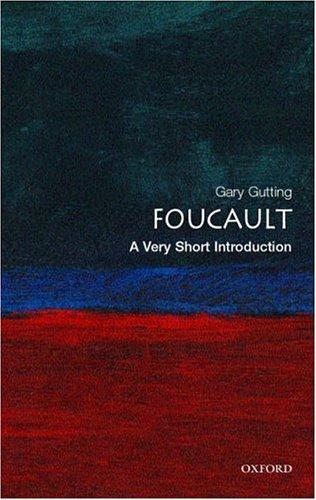
Covers belong to their publishers and are shown so you can recognise the book.
Philosophies they belong to or are close to
Who they connect to
Influenced
- Donna Haraway · She drew on Foucault's view of how power works through knowledge about bodies and life. (scholars disagree about this link)
- Edward Said · He used Foucault's account of how knowledge and power work together.
- Giorgio Agamben · He took up and extended Foucault's work on how states manage life.
- Judith Butler · She built her account of how norms shape people on Foucault's work on power.
Influenced by
- Friedrich Nietzsche · Foucault's genealogy is named after and modelled on Nietzsche's history of morals.
- Georges Bataille · Foucault praised him and took up his interest in transgression and limits.
- Martin Heidegger · Foucault said that Heidegger was the philosopher who mattered most to him.
Reacted against
- G. W. F. Hegel · Foucault spoke of the need to escape Hegel's model of history as one story.
- Jean-Paul Sartre · Foucault rejected Sartre's philosophy of the free subject as the centre of history.
Reacted against by
- Jurgen Habermas · The Philosophical Discourse of Modernity criticises Foucault for undermining the grounds of critique.
Other Modern European thinkers
- Arthur Schopenhauer · 1788 to 1860
- Alexis de Tocqueville · 1805 to 1859
- Thomas Henry Huxley · 1825 to 1895
- Wilhelm Dilthey · 1833 to 1911
- Friedrich Nietzsche · 1844 to 1900
- Sigmund Freud · 1856 to 1939
- Georg Simmel · 1858 to 1918
- Henri Bergson · 1859 to 1941
- Max Weber · 1864 to 1920
- Ernst Cassirer · 1874 to 1945
Sources we used
- Michel Foucault · Stanford Encyclopedia of Philosophy, read on 9 October 2026
- Foucault, Michel · Internet Encyclopedia of Philosophy, read on 9 October 2026