
Jean-Paul Sartre
Existentialist · Europe · 1905 to 1980
French writer who held that people are radically free and must make themselves through what they choose.
What it is
Jean-Paul Sartre (1905 to 1980) was a French philosopher, novelist, playwright and public intellectual who made existentialism famous with the claim that human beings are radically free and responsible for what they make of themselves. Few philosophers were as famous in their own lifetime. His difficult book Being and Nothingness set out the philosophy, and his novels and plays gave it a form that large audiences could follow.
He was born in Paris and met Simone de Beauvoir, Maurice Merleau-Ponty and others at the Ecole Normale Supérieure. His early work developed the phenomenology of Husserl, though he later diverged from him on method, on the self and on ethics. He also took in the ideas of Heidegger, and his main philosophical work appeared in 1943. He died in 1980.
The main ideas
- Radical freedom. Sartre held that the human condition is marked by groundlessness and radical freedom: nothing fixed in advance decides what a person must be. This is contrasted with the plain, unquestioned being of things. His slogan, 'existence precedes essence', says that people first exist and then make themselves what they are.
- Being in-itself and for-itself. Things simply are what they are. Consciousness is different: it is always consciousness of something, it can experience nothingness, and it can step back from what it is. That gives the self an intrinsic gap, so that the unity of the self is a task for a person, not a given.
- Bad faith. The danger of freedom is self-deception. In bad faith a person denies their own freedom and tries to be a thing, with a fixed nature, in order to escape responsibility for their choices.
- Literature as philosophy. Sartre's novels and plays, such as Nausea and the plays No Exit and Dirty Hands, dramatise the unstable mix of facts and freedom in an indifferent world.
- Freedom and politics. After the war he engaged increasingly in politics. He promoted Marxist ideas, spoke out on colonial wars and in 1964 turned down the Nobel prize for literature. His late work includes the long Critique of Dialectical Reason.
What it looks like in practice
Picture someone who says, 'I had no choice: that is just the kind of person I am.' Sartre's reply would be that this sentence is the evasion. Even under strong pressure there is something a person does with their situation, and describing themselves as a fixed type hides that. The task is not to feel guilty about every choice. It is to see that the choices are theirs, and to own them.
Books and moments
- Being and Nothingness (1943) is his philosophical masterpiece.
- Existentialism is a Humanism (1946) is a shorter, more accessible statement of his ideas.
- Critique of Dialectical Reason (1960) is his late, large work on society and history.
Questions and criticism
- Is freedom really total? It is fair to ask whether his picture leaves enough room for the effects of upbringing, history and social position.
- What happened to his reputation? His work received less academic attention from the 1970s to the 1990s, especially in France with the rise of post-structuralism, although his public fame remained.
- Can existentialism give an ethics? His early writing stresses freedom and responsibility. It is fair to ask what grounds a person's obligation to others if nothing fixed is given in advance.
Close neighbours
Sartre built on Husserl's phenomenology and Heidegger's analysis of human existence, and he is the best-known voice of existentialism. Simone de Beauvoir and Maurice Merleau-Ponty were fellow students of his. The page on existentialism describes the ideas he made famous.
Written by epchē in our own words, and checked against independent sources on 9 October 2026. The sources are listed below.
Where to start reading
Books by Jean-Paul Sartre or about them, from the easiest way in to the harder ones.
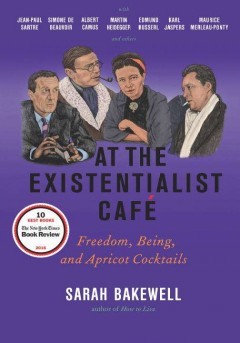
Covers belong to their publishers and are shown so you can recognise the book.
Philosophies they belong to or are close to
Who they connect to
Influenced
- Alain Badiou · He grew up under Sartre's influence and kept his stress on commitment. (scholars disagree about this link)
- Frantz Fanon · He drew on Sartre's thought and Sartre wrote the preface to his best-known book.
Influenced by
- Edmund Husserl · Sartre took up Husserl's idea that consciousness is always of something.
- G. W. F. Hegel · Sartre's account of recognition and conflict between persons uses Hegel's master and slave.
- Karl Marx · Sartre later tried to join existentialism with Marxism in his Critique of Dialectical Reason.
- Martin Heidegger · Sartre's Being and Nothingness draws heavily on Heidegger.
Reacted against
- Gabriel Marcel · The two argued openly, and Sartre set his own atheist existentialism against Marcel's.
Reacted against by
- Albert Camus · Camus rejected the existentialist label and split with Sartre over revolutionary politics.
- Maurice Merleau-Ponty · Merleau-Ponty rejected Sartre's sharp split between consciousness and world and his view of political commitment.
- Michel Foucault · Foucault rejected Sartre's philosophy of the free subject as the centre of history.
Runs parallel to
- Simone de Beauvoir · They worked in close exchange, while Beauvoir developed her own ethics of ambiguity.
Other Existentialist thinkers
- Søren Kierkegaard · 1813 to 1855
- Miguel de Unamuno · 1864 to 1936
- Karl Jaspers · 1883 to 1969
- Gabriel Marcel · 1889 to 1973
- Simone de Beauvoir · 1908 to 1986
Sources we used
- Jean-Paul Sartre · Stanford Encyclopedia of Philosophy, read on 9 October 2026
- Jean Paul Sartre: Existentialism · Internet Encyclopedia of Philosophy, read on 9 October 2026