
Existentialism
Existentialist · Europe · from 1840
Existentialism is a modern movement. Many of its best-known thinkers say life has no meaning ready-made for us. Each of us is free, and we make meaning through what we choose and do. That also means we are responsible for how we live.
What it is
Existentialism is a loose movement of mainly nineteenth and twentieth century European thinkers who start from the problem of human existence. They say we are not born with a fixed purpose, that each person is free and responsible for who they become, and that living honestly means facing that freedom.
It is not a single doctrine. Its groundwork was laid in the nineteenth century, and it took its public shape in mid twentieth century France. Many of the thinkers usually listed refused the word, so existentialism is better seen as a family of questions than as a school with a creed.
The main ideas
- Existence comes before essence. There is no fixed human nature that decides what a person is. We make ourselves by what we choose and do.
- Freedom and responsibility. Each person is free and bears the responsibility for their choices. That freedom is always situated, tied to a body, a history and a society.
- Anxiety. Seeing how much is open to us, and that no one else can choose for us, is unsettling. The existentialists treat that anxiety as revealing, not as an illness.
- Authenticity and bad faith. Living authentically means facing one's freedom and one's circumstances honestly. Bad faith is a self-deception that denies one of them.
- The absurd. The world gives no built-in reason or purpose in answer to human demands for one.
What it looks like in practice
Picture someone who has followed a path because it was expected: the right degree, the right job, the right city. An existentialist would not tell them to quit. They would ask them to notice that they chose it, every day, and could choose otherwise. Saying 'I had no choice' is, in this view, usually a way of hiding from the choice.
The goal is not constant upheaval. It is ownership: to be able to say of a life, whatever it contains, that it is mine.
People and moments
- Søren Kierkegaard (1813 to 1855) is counted among the key early existentialist thinkers. He stressed subjective truth and passionate commitment, with faith as a paradox beyond reason.
- Friedrich Nietzsche (1844 to 1900) wrote about the death of God and the need for people to create their own values.
- Martin Heidegger (1889 to 1976) studied human existence as being in the world and distinguished authentic from inauthentic ways of living.
- Jean-Paul Sartre (1905 to 1980) is the most public voice, with radical freedom and bad faith at the centre.
- Simone de Beauvoir (1908 to 1986) took the ideas into ethics and feminist thought, especially in The Second Sex.
- Albert Camus (1913 to 1960) wrote on the absurd and on revolt as a response to it.
Questions and criticism
- Who counts? Of the thinkers usually listed, few openly called themselves existentialists. The label may do more harm than good for this reason.
- Faith or no faith? Religious existentialists, with Kierkegaard as the example, differ from atheist ones, with Sartre as the example.
- How free are we? Is freedom total, as Sartre held, or always limited by one's situation? The disagreement has not gone away.
- Obscure and political? Critics complain that some of the writing is obscure and that it says too little about social and political structures.
Close neighbours
Existentialism overlaps with nihilism, which also says that meaning is not given, and with absurdism. It differs from both in what it asks of a person: to make meaning and to own it. Nietzsche is a bridge to perspectivism.
Written by epchē in our own words, and checked against independent sources on 7 October 2026. The sources are listed below.
Where to start reading
Books for this philosophy, from the easiest way in to the harder ones. Each is chosen for a newcomer, whatever the shop.
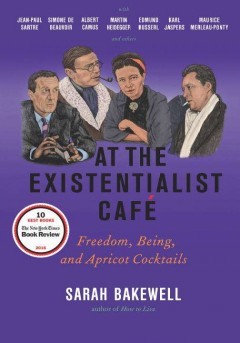
Covers belong to their publishers and are shown so you can recognise the book.
What it holds
These are the questions this philosophy cares about most and the side it leans toward. They are our reading of it, and the same positions the walk uses.
- We make meaning, or there is none · clearly Does life have a purpose before you choose anything?
- What we make of life matters · clearly If life has no built-in purpose, does the meaning we make for ourselves still count?
- Some choices are truly open · clearly Are some choices left open by what came before, or do earlier causes fix everything you do?
- The person comes first · clearly When a person's wishes and the community's needs pull apart, which should come first?
- Right and wrong depend on people · clearly Are some moral rules true for everyone, everywhere?
- All within this world · leaning Is everything that matters found inside this world, or does it point to something beyond it?
- No clash: we make meaning · leaning When the world gives no meaning, is that a freedom, so we make our own and move on?
Ideas it speaks to
Short articles on the questions this philosophy answers most firmly.
- Meaning given or made · leans toward: We make meaning, or there is none
- Does the meaning we make still count · leans toward: What we make of life matters
- Free will and determinism · leans toward: Some choices are truly open
- The person or the community first · leans toward: The person comes first
- Moral relativism and universal morality · leans toward: Right and wrong depend on people
- Does meaning need something beyond this world · leans toward: All within this world
Compared with
Thinkers
Related philosophies
Runs parallel to
- Nihilism · Both start from a world with no given meaning. Existentialism asks how to live in it. Nihilism stops at the loss.
- Pragmatism · Both put lived choice above fixed systems, though they differ on almost everything else. (scholars disagree about this link)
More from the Existentialist tradition
Sources we used
- Existentialism · Stanford Encyclopedia of Philosophy, read on 7 October 2026
- Existentialism · Internet Encyclopedia of Philosophy, read on 7 October 2026
Where do you stand?
Every philosophy takes sides. Here is one question Existentialism answers firmly:
Does life have a purpose before you choose anything?
- Existentialism leans toward: We make meaning, or there is none
- The other side: Meaning is given to us
The walk asks about this and the questions around it, two ideas at a time, and shows which philosophies your own answers sit closest to. No account, and your answers stay on your device.