
Thomas Kuhn
American · North America · 1922 to 1996
American historian and philosopher of science who held that science changes through sudden shifts in its basic framework.
What it is
Thomas Kuhn (1922 to 1996) was an American historian and philosopher of science, and one of the most influential philosophers of science of the twentieth century. His book The Structure of Scientific Revolutions (1962) is among the most cited academic books ever written. It changed how people think about the way science changes.
He began in physics, finishing a doctorate in that subject at Harvard in 1949, and then moved into the history of science and later the philosophy of science. He taught history of science at Harvard in the 1950s. His famous book first appeared in an encyclopedia series published by the logical positivists, the group whose ideas it went on to challenge. He died in 1996.
The main ideas
- Science does not just add up. Before Kuhn, science was often pictured as the steady addition of new truths. He argued that it moves through periods of stable growth that are broken by revolutions.
- Normal science. In ordinary times scientists share a framework of theories, instruments, values and assumptions, and their work is largely solving puzzles within it.
- Revolutions. When serious anomalies pile up, the framework itself is revised. This is a scientific revolution, and it changes what counts as a good problem and a good solution.
- Paradigms. We judge a theory not by applying a fixed set of rules but by comparing it with an accepted example of good work, a paradigm.
- Seeing differently. What a scientist observes depends partly on the theory they hold, so a revolution can change what scientists see in the same evidence.
- Incommensurability. Theories from different periods may not be fully comparable. They can disagree about which problems matter, and later he argued that some translation between them fails. This is his most controversial thesis.
What it looks like in practice
Picture two groups of scientists who look at the same experiment and disagree about what it shows, because they are working under different frameworks. Kuhn would ask what each framework counts as a problem and a solution, before asking who is right. This is an illustration of his line of questioning, not a passage from his writing.
Books and moments
- The Structure of Scientific Revolutions (1962) is his best-known book, on normal science, paradigms and revolutions.
Questions and criticism
- Is incommensurability too strong? The thesis that theories from different periods cannot be fully compared is controversial, and Kuhn himself reworked it over the years.
- Stretched examples. Some of his illustrations are described as strained. His example that Lavoisier saw oxygen where Priestley saw "dephlogisticated air" is one.
- Does science still progress? If standards of judgment shift with paradigms, it is fair to ask in what sense later science is better than earlier science.
Close neighbours
The pages on Rudolf Carnap and W. V. Quine show two thinkers he was in conversation with. Carnap co-edited the series of volumes in which the book first appeared, and Kuhn compared his thesis about translation to a thesis of Quine.
Written by epchē in our own words, and checked against independent sources on 29 October 2026. The sources are listed below.
Where to start reading
Books by Thomas Kuhn or about them, from the easiest way in to the harder ones.
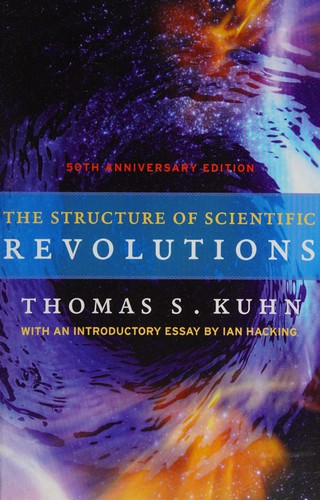
Covers belong to their publishers and are shown so you can recognise the book.
Who they connect to
Influenced
- Bruno Latour · He took up the view that science changes through the practices of its communities. (scholars disagree about this link)
- Paul Feyerabend · The two exchanged ideas on how scientific frameworks differ and cannot be directly compared. (scholars disagree about this link)
Reacted against
- Karl Popper · He argued that scientists rarely try to disprove their framework, as Popper said they should, until it is in crisis.
Reacted against by
- Imre Lakatos · He argued that Kuhn's account of scientific change makes it look like mob rule, and gave a more rational one.
Other American thinkers
- Ralph Waldo Emerson · 1803 to 1882
- Henry David Thoreau · 1817 to 1862
- Charles Sanders Peirce · 1839 to 1914
- William James · 1842 to 1910
- Josiah Royce · 1855 to 1916
- John Dewey · 1859 to 1952
- George Santayana · 1863 to 1952
- Roy Wood Sellars · 1880 to 1973
- Ayn Rand · 1905 to 1982
- Paul Kurtz · 1925 to 2012
Sources we used
- Thomas Kuhn · Stanford Encyclopedia of Philosophy, read on 29 October 2026
- Thomas Kuhn · Wikipedia, read on 29 October 2026