
Ayn Rand
American · North America · 1905 to 1982
Russian-born American novelist who developed Objectivism. She argued for reason, rational self-interest and free-market capitalism.
What it is
Ayn Rand (1905 to 1982) was a Russian-born American novelist and philosopher. She was born Alissa Rosenbaum in St Petersburg to a Jewish middle-class family and lived through the Russian Revolution and civil war, opposing both the Communists and the Tsarists. She moved to the United States in 1926. She is known for her novels, among them We the Living (1936) and Atlas Shrugged, and for the philosophical system she called Objectivism.
She set out her views on knowledge, ethics and art in novels and essays. Her philosophy begins from the claim that reality exists independently of anyone's mind and that people should use reason to understand it and to guide their lives.
The main ideas
- Objectivity. She sorted things into the intrinsic, the subjective and the objective, and from this contrast took the name of her philosophy. Something is objective when it is a relation between a mind and reality, not wholly in the world and not wholly in the head.
- Why ethics? Ethics is a code of values to guide a person's choices and actions. She held that no earlier philosopher had given a scientific answer to why anyone needs one.
- Survival as the standard. She took one's own survival as a human being as the standard of value, and held that to accept it is to accept reason, purpose and self-esteem as the central values.
- Virtues. The matching virtues are rationality, productiveness and pride.
- Happiness. Happiness is the successful state of life, an emotion that follows from living by one's values.
- Philosophy through fiction. She believed that a novel could present an ideal, and said that her first love was the creation of a world showing human perfection.
- Politics. In her political writing she favoured individualism and a free-market economy, and her ideas were influential among libertarians.
What it looks like in practice
Imagine choosing between two jobs, one that is safe and dull and one that uses all your skill. Rand would ask what values you are trying to live by, and say that your choices are judged by how they serve your own life as a rational person, not by whether others approve. This is an illustration of her line of questioning, not a passage from her writing.
Books and moments
- We the Living (1936) is her first and most autobiographical novel, set in the Soviet Union.
- Atlas Shrugged is her magnum opus, a novel that carries her philosophy.
- Her essays on ethics and on knowledge, such as those on the objective and the subjective, set out Objectivism directly.
Questions and criticism
- Reading survival. Scholars disagree about how literally to read her standard of value as survival.
- Philosophy in novels. Because she presented her ideas in novels and essays, it is fair to ask how far they were argued as philosophy.
- A sharp divide. Her work is admired by some and rejected by others, and it is fair to ask how to weigh its claims on their merits.
Close neighbours
The pages on Immanuel Kant and John Stuart Mill show two very different answers to what grounds ethics, against which her view can be read.
Written by epchē in our own words, and checked against independent sources on 29 October 2026. The sources are listed below.
Where to start reading
Books by Ayn Rand or about them, from the easiest way in to the harder ones.
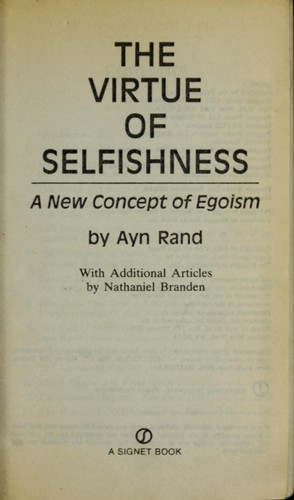
- Objectivism: The Philosophy of Ayn Rand Leonard Peikoff
Covers belong to their publishers and are shown so you can recognise the book.
Philosophies they belong to or are close to
Other American thinkers
- Ralph Waldo Emerson · 1803 to 1882
- Henry David Thoreau · 1817 to 1862
- Charles Sanders Peirce · 1839 to 1914
- William James · 1842 to 1910
- Josiah Royce · 1855 to 1916
- John Dewey · 1859 to 1952
- George Santayana · 1863 to 1952
- Roy Wood Sellars · 1880 to 1973
- Thomas Kuhn · 1922 to 1996
- Paul Kurtz · 1925 to 2012