
Robert Nozick
American · North America · 1938 to 2002
American philosopher whose 1974 book Anarchy, State, and Utopia argued that only a minimal state can be justified.
What it is
Robert Nozick (1938 to 2002) was an American philosopher, born in Brooklyn, who taught at Harvard. He is best known for his 1974 book Anarchy, State, and Utopia, which argues that only a minimal state, one limited to protecting people from violence, theft and fraud, can be morally justified.
The book was written as an answer to John Rawls and his A Theory of Justice (1971), and the two books are often read side by side as the main statements of two opposed views of what a state owes its citizens. Nozick later wrote on knowledge too, but this book remains the work he is known for.
The main ideas
- People are ends, not tools. Following Kant, he held that individuals must never be treated merely as means. From this he drew the idea that people own themselves and have rights, and that these rights act as limits on what anyone, the state included, may do to them.
- The minimal state. The state, on his view, should be limited to protecting people from violence, theft and fraud, together with the courts to settle disputes. Other tasks that modern governments take on are left to private bodies and a free market.
- Entitlement theory. A distribution of wealth is just if everyone in it is entitled to what they hold, meaning they got it by a fair first acquisition, by voluntary transfer, or by the repair of an earlier injustice.
- Against patterns. He rejected theories that judge a society by whether its wealth fits a favoured pattern or end result. What matters, he said, is how the holdings came about.
- Wilt Chamberlain. To make the point he imagined a society whose wealth is shared out in a pattern that his opponent accepts as just. If many people then freely pay a little extra to watch the basketball player Wilt Chamberlain, the pattern is upset by ordinary choices, and he asked what exactly would then be unjust.
- Taxation as forced labour. He held that redistributive taxation is a kind of forced labour, because part of a person's working time is spent for others without consent.
What it looks like in practice
Imagine a group of friends who set up a small shared fund, each paying in only what they agree to, and a neighbour who says everyone in the street should be made to pay in. A reader of Nozick would ask whether anyone has the right to force the neighbour to join, and what makes the street's claim stronger than the neighbour's own. This is an illustration of the kind of question he asked, not a passage from his book.
Books and moments
- Anarchy, State, and Utopia (1974), his best-known book.
- Philosophical Explanations (1981), a later book that offered a theory of knowledge in terms of what would be true if things were otherwise.
- Princeton. He studied there under the philosopher Carl Hempel.
Questions and criticism
- Does the minimal state allow too little? Rawls and his followers hold that a fair distribution of wealth requires more than a minimal state. Nozick held that any larger state would violate people's rights. Which side is right is the point at issue.
- Rawls's difference principle. The book challenges the idea that inequalities are justified only when they benefit the least-advantaged members of society. Whether it succeeds is exactly what the two camps dispute.
- Where does a first claim come from? Entitlement depends on how things were first acquired and on whether past wrongs were put right. It is fair to ask how anyone could check that for the holdings of today.
Close neighbours
The pages on John Rawls and Friedrich Hayek are the nearest, one as his opponent and the other as an earlier defender of free markets. The pages on John Locke and Immanuel Kant stand behind his ideas of rights and of persons as ends.
Written by epchē in our own words, and checked against independent sources on 29 October 2026. The sources are listed below.
Where to start reading
Books by Robert Nozick or about them, from the easiest way in to the harder ones.
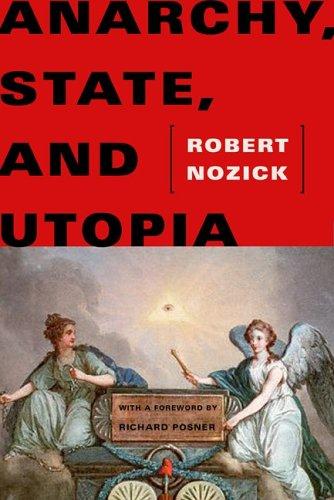
Covers belong to their publishers and are shown so you can recognise the book.
Philosophies they belong to or are close to
Who they connect to
Reacted against by
- G. A. Cohen · He attacked Nozick's claim that people fully own themselves and what they earn.
Other American thinkers
- Ralph Waldo Emerson · 1803 to 1882
- Henry David Thoreau · 1817 to 1862
- Charles Sanders Peirce · 1839 to 1914
- William James · 1842 to 1910
- Josiah Royce · 1855 to 1916
- John Dewey · 1859 to 1952
- George Santayana · 1863 to 1952
- Roy Wood Sellars · 1880 to 1973
- Ayn Rand · 1905 to 1982
- Thomas Kuhn · 1922 to 1996
Sources we used
- Robert Nozick · Internet Encyclopedia of Philosophy, read on 29 October 2026
- Robert Nozick · Encyclopaedia Britannica, read on 29 October 2026
- Robert Nozick · Wikipedia, read on 29 October 2026
Read more elsewhere
- Stanford Encyclopedia of Philosophy · long and detailed, written by specialists